
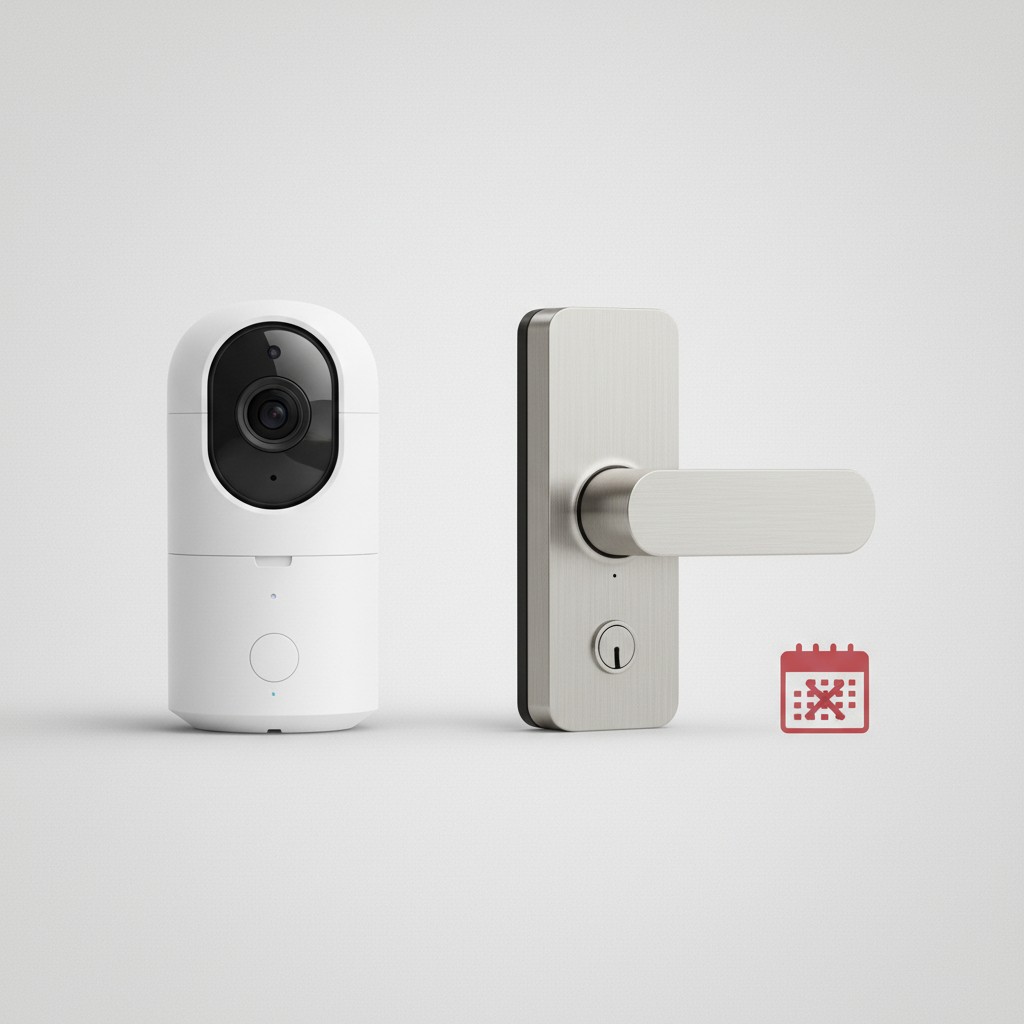
The average smart home owner is paying somewhere between $300 and $600 a year in device subscription fees, and that number has been climbing rather than holding steady. Wyze raised its camera subscription price to $29.99 a month in March 2026, a 50% jump from what customers were paying before. Multiply that across a camera subscription, a video doorbell plan, and maybe a smart lock’s cloud tier, and a smart home that felt like a one-time hardware purchase quietly turns into a recurring bill that outpaces what the devices themselves cost.
Every major smart home category, cameras, doorbells, thermostats, locks, lights, sensors, even robot vacuums, now has at least one genuinely good option that skips the subscription entirely. The trade-off isn’t “cheaper but worse.” It’s usually “pay more upfront, own your data locally, never get a monthly bill again.”
Cameras and Doorbells: Local Storage Is the Dividing Line
The subscription fee on most cameras and doorbells is really a cloud storage fee: the device itself is often perfectly capable of recording locally, but the manufacturer routes that footage through their servers and charges monthly for the privilege of retrieving it later. Brands built around local storage sidestep this by design. Reolink and UniFi Protect both store footage on a microSD card or a network video recorder sitting in your own home, with live view, motion alerts, and playback handled without a mandatory monthly fee. Eufy has built its whole brand positioning around the same local-storage approach. The honest caveat: local storage means the footage lives on hardware that can fail or be stolen along with the camera, so it’s a genuine trade against cloud backup’s redundancy, not a strictly-better option in every dimension, just a strictly-cheaper one over time for most households.
Comprehensive Systems That Skip the Monthly Fee Entirely
For a full home security setup rather than individual cameras, a small number of systems are built explicitly around a one-time hardware cost with no recurring plan. The Abode Smart Security Kit runs $199 for a hub, door sensor, motion sensor, and keyfob, with self-monitoring at $0 a month, a genuinely different pricing model from the professional-monitoring subscriptions that dominate most of this category. Arlo similarly offers tiers that let you keep an eye on your home without a mandatory monthly plan, which matters for anyone who wants the peace of mind of a security system without accepting an open-ended recurring cost as the price of entry.
Thermostats, Locks, Lighting, and Plugs
Outside of cameras, the subscription trap is less common but not absent. Most smart thermostats, smart locks, smart lighting and switches, and smart plugs on the market today genuinely don’t require a subscription to function at their core level, local scheduling, app control, and basic automation typically work without a monthly plan across most major brands. Where subscriptions creep back in is usually around advanced features layered on top: extended historical data, integration with a professional monitoring service, or AI-powered detection features on top of basic motion sensing. Reading the fine print on what’s gated behind a paid tier versus included in the base purchase is worth doing before buying, since the base device and the “smart” version of it are sometimes marketed identically despite meaningfully different feature sets.
Water Leak Detectors and Irrigation Controllers
These two categories are worth calling out specifically because they’re inexpensive relative to the damage they prevent, and virtually all of them operate subscription-free by default. A water leak detector sitting near a water heater or under a sink costs a fraction of what a burst pipe cleanup runs, and the entire category has settled on local alerts and app notifications with no recurring fee as the norm rather than the exception. Smart irrigation controllers follow the same pattern: weather-based watering schedules and app control ship as core features, not as an upsell.
Robot Vacuums Are Catching Up to the Same Pattern
Robot vacuums are a newer addition to the subscription conversation, but the same dividing line is starting to show up here too. Higher-end models increasingly gate features like AI-based obstacle recognition, room-specific cleaning history, or multi-floor mapping storage behind an app subscription, even though the vacuum’s core cleaning function doesn’t need cloud processing to work. A vacuum that maps and stores its floor plan locally on the device, rather than in a manufacturer’s cloud account, tends to keep those features included in the base purchase price instead of layering a monthly fee on top. It’s a smaller dollar amount than a camera subscription in most cases, but it follows the identical pattern: check whether “smart” mapping features are core to the device or gated behind a plan before assuming the sticker price is the whole cost.
Checking a Device You Already Own Before Assuming It’s Locked In
Before buying anything new specifically to escape a subscription, it’s worth checking whether a device you already own actually requires the paid tier for the features you personally use. Manufacturers sometimes default new accounts into a subscription trial and never clearly surface the free-tier feature set afterward, which means a camera or doorbell purchased specifically for its subscription plan may still work perfectly well on live view and basic motion alerts once the trial lapses, just without cloud clip history. Digging into the account settings to see exactly what breaks without the subscription, rather than assuming the device becomes useless, occasionally turns “I need to replace this” into “I can just let the trial expire,” which is the cheapest possible fix in the entire subscription conversation.
Home Assistant as the Unifying Layer
For anyone accumulating devices across several of these categories, a free, open-source hub like Home Assistant ties them together under one roof, running on hardware you own rather than a company’s cloud servers. This matters beyond just avoiding subscription fees: it also solves the fragmentation problem of needing five different apps for five different brands, since Home Assistant can bring compatible devices from Reolink, Eufy, various lock and thermostat brands, and more into a single interface and a single set of automations. It’s a bigger setup commitment than buying subscription-free devices individually, but it’s the difference between “a collection of subscription-free gadgets” and “an actual integrated smart home” for anyone building toward the latter.
The Math Worth Doing Before You Buy
Subscription-free devices are almost always more expensive upfront than their subscription-dependent equivalents, since the manufacturer is recovering that cost difference at the point of sale instead of over time. The way to evaluate whether that trade is worth it is a simple break-even calculation: take the subscription-free device’s price premium over a comparable subscription-based option, and divide it by that competitor’s monthly fee. A camera that costs $60 more upfront but saves $10 a month pays for itself in six months and is pure savings after that, for as long as you keep the device. Run that math category by category rather than assuming subscription-free is automatically the better deal; for a device you’ll replace or upgrade within a year anyway, the subscription-based option can still come out cheaper in practice, even though it feels like the worse long-term choice on principle.
Building It Out Gradually
Nobody needs to replace an entire smart home’s worth of subscription-dependent devices at once, and trying to usually means overspending on hardware before confirming which categories actually justify the switch for your household. The more sustainable approach is picking the single subscription that annoys you most, usually a camera or doorbell plan, since those tend to carry the highest recurring fees, and replacing just that category first. If the break-even math works out and the local-storage trade-off suits how you actually use the device, expanding to other categories from there becomes a much easier decision, backed by real experience rather than a spreadsheet estimate.
*Source: Aggregated from multiple 2026 no-subscription smart home guides, including Smart Home Perfected’s No Subscription Smart Home Database and independent 2026 coverage of subscription-free home security options.*