Portable AC Unit: Key Takeaways
- A portable AC unit’s advertised BTU rating often exceeds real cooling because the test conditions rarely match single-hose operation.
- Single-hose portable ac units create negative pressure that draws unconditioned air in, lowering effective cooling below the rated BTU.
- Dual-hose portable ac units avoid this pressure loss and deliver cooling closer to their rated capacity, though they cost more and need two window ports.
- The DOE now requires a Seasonally Adjusted Cooling Capacity rating, which gives a more realistic comparison than the older ASHRAE figure.
A portable air conditioner’s advertised BTU rating is one of the more consistently overstated specs in home electronics, not through outright false advertising, but through a testing standard that measures cooling capacity under conditions a single-hose portable unit rarely achieves in actual use. Understanding why the box number doesn’t match real-world cooling is the single most useful thing to know before buying one.
Table of Contents
Single-Hose Units Create Negative Pressure
The large majority of portable air conditioners on the market use a single exhaust hose that vents hot air outside through a window kit, while pulling the air it exhausts from inside the room it’s cooling. This creates a slight negative pressure inside the room, which then pulls replacement air in through any gap, under doors, around window seals, from other parts of the house, that hasn’t been cooled at all.
The unit ends up working to cool air that’s constantly being replenished with warm, unconditioned air from elsewhere, reducing real effective cooling meaningfully below the rated BTU figure.
Dual-Hose Units Solve This, at a Real Cost and Size Trade-Off
A dual-hose portable AC draws the air used for its internal cooling process from outside through one hose, and exhausts hot air through a second, separate hose, rather than pulling either from the room being cooled. This avoids the negative-pressure problem entirely and delivers cooling performance meaningfully closer to the unit’s rated BTU capacity. Dual-hose units cost more, take up more space, and need two hose ports at the window rather than one, which is the real trade-off for the improved actual performance.
The DOE Testing Standard Change Worth Knowing About
A U.S. Department of Energy testing standard update required portable AC manufacturers to report a “Seasonally Adjusted Cooling Capacity” figure, a more realistic measure than the older ASHRAE rating, specifically because the older standard overstated real-world performance so consistently. When comparing two units, checking for this newer, more realistic rating, rather than comparing older-style headline BTU numbers alone, gives a genuinely more accurate sense of actual cooling capability between models.
Sizing to Room Size, With a Real Adjustment for Hose Type
General portable AC sizing guidance starts from square footage, roughly 200 to 400 square feet per unit of moderate capacity depending on ceiling height, sun exposure, and climate. Because single-hose units lose real capacity to the negative-pressure effect described above, sizing conservatively upward for a single-hose unit, or specifically favoring a dual-hose unit for a larger or harder-to-cool room, avoids under-cooling relative to the advertised rating.
Noise Is a Real, Often-Overlooked Factor
Portable air conditioners sit inside the room they cool, unlike a window unit that’s mostly outside the window frame, meaning their compressor noise is directly in the living space rather than partially outdoors. Noise levels vary meaningfully between models at similar cooling capacity, and it’s worth checking a specific unit’s decibel rating, particularly for a bedroom or home office, since a loud unit running continuously through a hot week is a real quality-of-life factor easy to overlook while comparing cooling specs alone.
A Practical Buying Approach
- Favor dual-hose over single-hose when cooling performance matters most, particularly for larger rooms, hot climates, or poorly sealed windows.
- Look specifically for the newer Seasonally Adjusted Cooling Capacity rating when comparing units, rather than the older, more inflated ASHRAE BTU figure alone.
- Size upward from standard square-footage guidance for single-hose units specifically, to compensate for their real-world capacity loss.
- Check the decibel rating for units intended for bedrooms or quiet workspaces, since noise varies meaningfully between similarly rated models.
The Honest Trade-Off
A portable air conditioner is a genuinely useful cooling solution for a room without central air or a compatible window for a traditional unit, but the BTU number on the box overstates real performance more than almost any other cooling appliance, specifically because of how single-hose designs pull replacement air. Understanding the hose-type difference, and checking for the newer, more honest capacity rating, is the difference between a unit that actually cools a room and one that runs constantly while barely keeping up.
Bottom Line
Choose a dual-hose portable AC unit for larger rooms and verify the Seasonally Adjusted Cooling Capacity rating before buying. Then measure your space and compare the rating to the recommended square-footage range.
Related Reading
- ‘HEPA-Type’ Filters Let Through Up to 150 Times More Particles Than True HEPA. The Label Difference Is One Word.
- A Portable Generator and a Home Standby System Solve Different Problems Entirely
- That Ultra-Compact External SSD Can Lose Half Its Speed 30 Seconds Into a Large File Transfer. Here’s Why.
Sources: Federal Register: DOE test procedures for portable air conditioners.
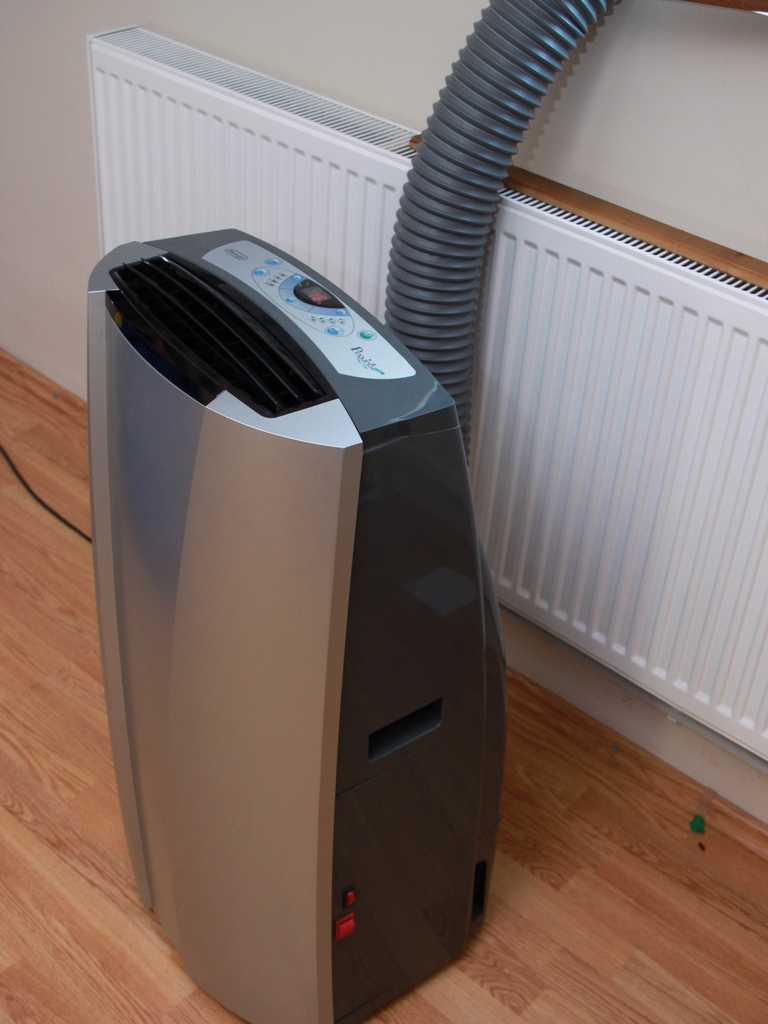
Photo credit: “Portable-Air-Conditioner_DeLonghi-PAC-T100-__50123” by Public Domain Photos, licensed BY (https://creativecommons.org/licenses/by/2.0/). Source: https://www.flickr.com/photos/28958738@N06/7002031177