
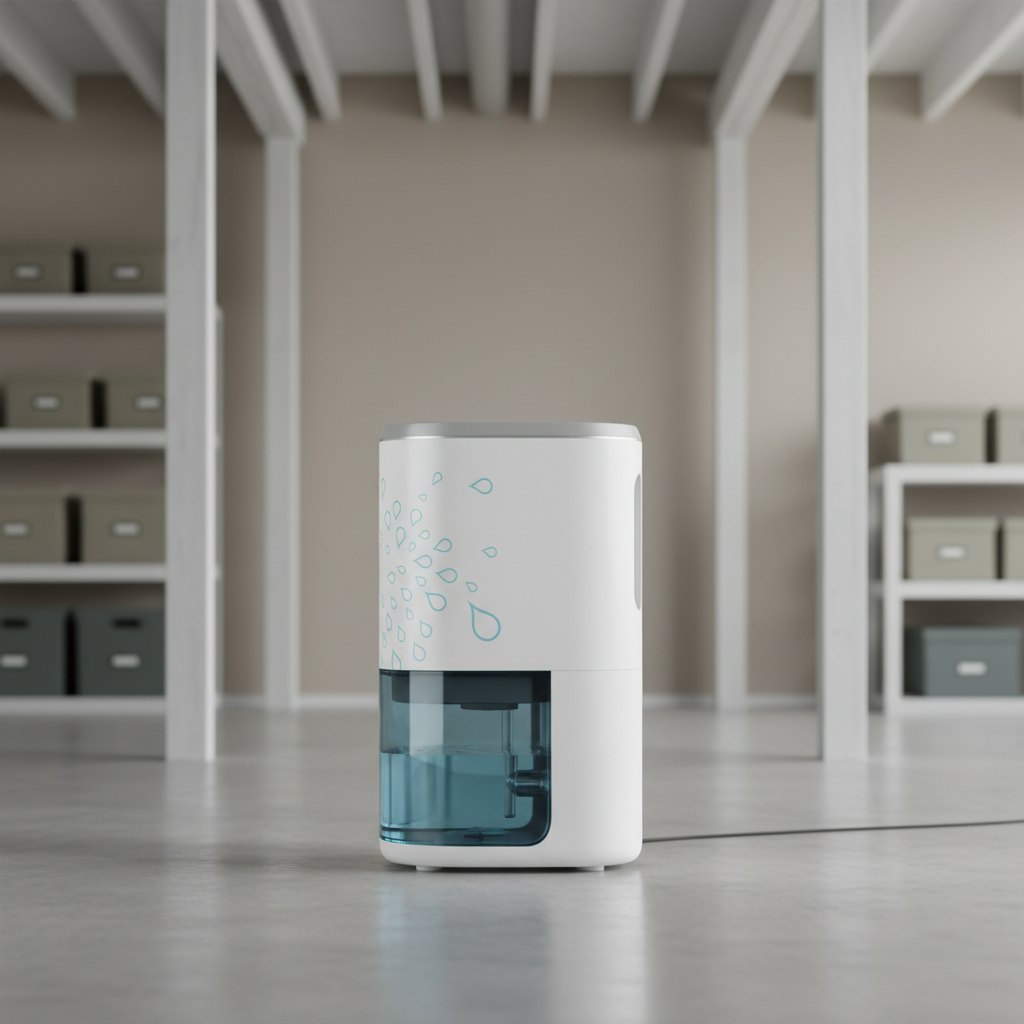
A dehumidifier’s capacity rating, measured in pints of water removed per day, is tested under a specific set of conditions that many of the rooms people actually buy dehumidifiers for, especially basements, don’t match. Buying based on square footage and the pint rating on the box alone leads to a common outcome: a unit that runs nearly continuously and never quite gets the space to a comfortable humidity level.
Table of Contents
Why the Box Rating Doesn’t Match Real Conditions
Dehumidifier capacity is tested at a specific temperature and humidity level. Since a 2019 change in the U.S. test, that temperature is 65 degrees Fahrenheit rather than the old 80, so newer ratings are lower and more realistic than older listings, but spaces colder than 65 still fall short. Cooler spaces, which describes most basements for a significant part of the year, cause a standard dehumidifier to remove meaningfully less water than its rated capacity, since the dehumidification process is less effective at lower temperatures.
This is the single biggest reason a dehumidifier that seems correctly sized on paper struggles in an actual basement.
Sizing Charts Are a Starting Point, Not the Final Answer
Standard sizing guidance scales pint capacity to square footage and how damp the space already is, from “moderately damp” to “extremely wet” with visible mold or standing water. These charts are a reasonable starting point, but they assume standard indoor temperatures; a basement, crawlspace, or unheated space running cooler than a typical living room should be sized up from the chart’s baseline recommendation, not matched to it exactly, to compensate for reduced real-world capacity in cooler air.
Low-Temperature Dehumidifiers Solve the Basement Problem Directly
A subset of dehumidifiers are specifically engineered to maintain rated capacity at lower temperatures, commonly rated to continue operating effectively down into the 40s Fahrenheit, well below where a standard model’s performance drops off. These units cost more than a standard dehumidifier of the same pint rating, but for a genuinely cold basement or crawlspace, a standard unit sized up to compensate can still underperform a properly rated low-temperature unit, making the low-temp model the more reliable choice despite the higher price.
The Auto-Defrost Feature That Actually Matters in Cold Spaces
Standard dehumidifiers can develop frost on their internal coils in cooler conditions, which blocks airflow and can damage the unit if it continues running without addressing it. An auto-defrost feature detects this and temporarily pauses or adjusts operation to clear the frost before resuming. This feature matters specifically for cooler spaces like basements and is one of several differences between low-temperature-rated models and standard ones.
Continuous Drainage vs. Manual Bucket Emptying
Most dehumidifiers include an internal water tank that needs manual emptying once full, which in a genuinely damp space can mean daily or even more frequent emptying. Most models also support a continuous drain hose option, routing collected water directly to a nearby floor drain or sump pump rather than collecting it in the tank at all.
For a basement or any space expected to run the dehumidifier frequently, setting up continuous drainage from the start avoids the single most common reason people stop using a dehumidifier consistently: the tank filling faster than anyone remembers to empty it.
A Practical Buying Approach
- Size up from the standard chart recommendation for any space cooler than typical room temperature, rather than matching the chart exactly.
- Choose a low-temperature-rated model for a genuinely cold basement or crawlspace, rather than compensating with a larger standard unit alone.
- Check for auto-defrost specifically if the space runs cool, since frost buildup is one of the common ways standard units underperform in cold conditions.
- Set up continuous drainage for any space expected to need frequent dehumidification, to avoid the tank-emptying problem that causes most units to fall out of regular use.
The Honest Trade-Off
A dehumidifier’s pint rating on the box is accurate only under the specific conditions it was tested at, which makes it a meaningfully less reliable sizing guide for a cold basement than for a normal living space. Sizing up and choosing a genuinely low-temperature-rated model for cold spaces costs more upfront but avoids the common outcome of a dehumidifier that runs constantly while the room stays stubbornly damp.
Related Reading
- The BTU Number on a Portable AC Box Is Almost Always Inflated
- A Portable Generator and a Home Standby System Solve Different Problems Entirely
- ‘HEPA-Type’ Filters Let Through Up to 150 Times More Particles Than True HEPA. The Label Difference Is One Word.
Sources: ENERGY STAR: dehumidifiers.
Illustration: AI-generated for iLuxeMart.