Curved Monitor: Key Takeaways
- A curved monitor works for a single close viewer because the curve keeps screen edges at the same eye distance as the center.
- Curved TVs failed because off-center viewers lost picture quality, but a curved monitor avoids this since only one person uses it.
- Extreme ultrawides like the 55-inch Odyssey Ark need a curved monitor shape to prevent uncomfortable viewing distances to far edges.
- The curve reduces eye strain on wide screens for tasks like spreadsheets or video editing, not just gaming.
Samsung sold curved TVs for years before quietly dropping the format by 2020, the last major manufacturer to give up on it. The exact same curved-screen technology, meanwhile, is thriving in gaming monitors right now, with ultrawide curved models like the 34-inch Alienware and Samsung’s 55-inch Odyssey Ark treated as premium, desirable hardware rather than a gimmick anyone’s trying to phase out.
Table of Contents
Same curve, opposite outcomes. That’s not a coincidence or a fashion cycle; it comes down to one variable that TVs and monitors handle completely differently: how far you sit from the screen, and whether more than one person is looking at it at the same time.
Curved TVs Never Solved the Sweet-Spot Problem
A curved screen only looks right from roughly the center of its curve. Sit off to the side and the image on an LCD curved TV loses contrast and color accuracy fast, a problem that gets worse on darker content; a dim scene in something like Game of Thrones was a common example of how badly this showed up in practice.
Curved OLED TVs mostly avoided the color-shift issue, but at a real cost premium over an equivalent flat OLED, which undercut the value case even for buyers who liked the look.
TV-watching is rarely a single-viewer activity. A couch seats more than one person, and everyone off-center from the sweet spot got a visibly worse picture than whoever sat dead center. A feature that actively made the picture worse for most of the room isn’t a small tradeoff; it’s a fundamental mismatch with how TVs get watched in practice.
Manufacturing a Curve Gets Harder as the Screen Gets Bigger
Beyond the viewing-angle problem, there was a real production constraint working against curved TVs specifically because of their size. Dipin Sehdev, founder of CE Critic, has described curved panels in the 55 to 75-inch range as “very difficult to manufacture and ship and keep the uniformity as best as they can.” Bigger curved glass is harder to produce consistently and harder to ship without damage than a flat panel of the same size, adding real cost and yield problems on top of a feature that was already a hard sell.
The Curve Physically Didn’t Fit Modern Walls
There’s also a mundane, practical reason curved TVs lost out that has nothing to do with picture quality: the curve itself. A curved TV’s corners protrude roughly 6 inches further off the wall than a flat panel does, which is a real problem for anyone trying to mount it flush the way flat TVs are now expected to sit. Consumers had clearly settled on slim, wall-hugging TVs as the standard, and a curved TV couldn’t deliver that regardless of how good the picture looked dead-center.
A Monitor Only Has One Viewer
Every problem above stems from the same root cause: a TV has to work for a room full of people at a distance of 6 to 10 feet, and a curved screen only genuinely works for one person at a much shorter distance. A monitor is built around exactly that single-viewer, close-distance situation from the start.
The “off-center problem” that sank curved TVs simply doesn’t apply when there’s only ever one seat in front of the screen, sitting close enough that the curve is doing real, felt work rather than being a hidden flaw waiting for the wrong seat.
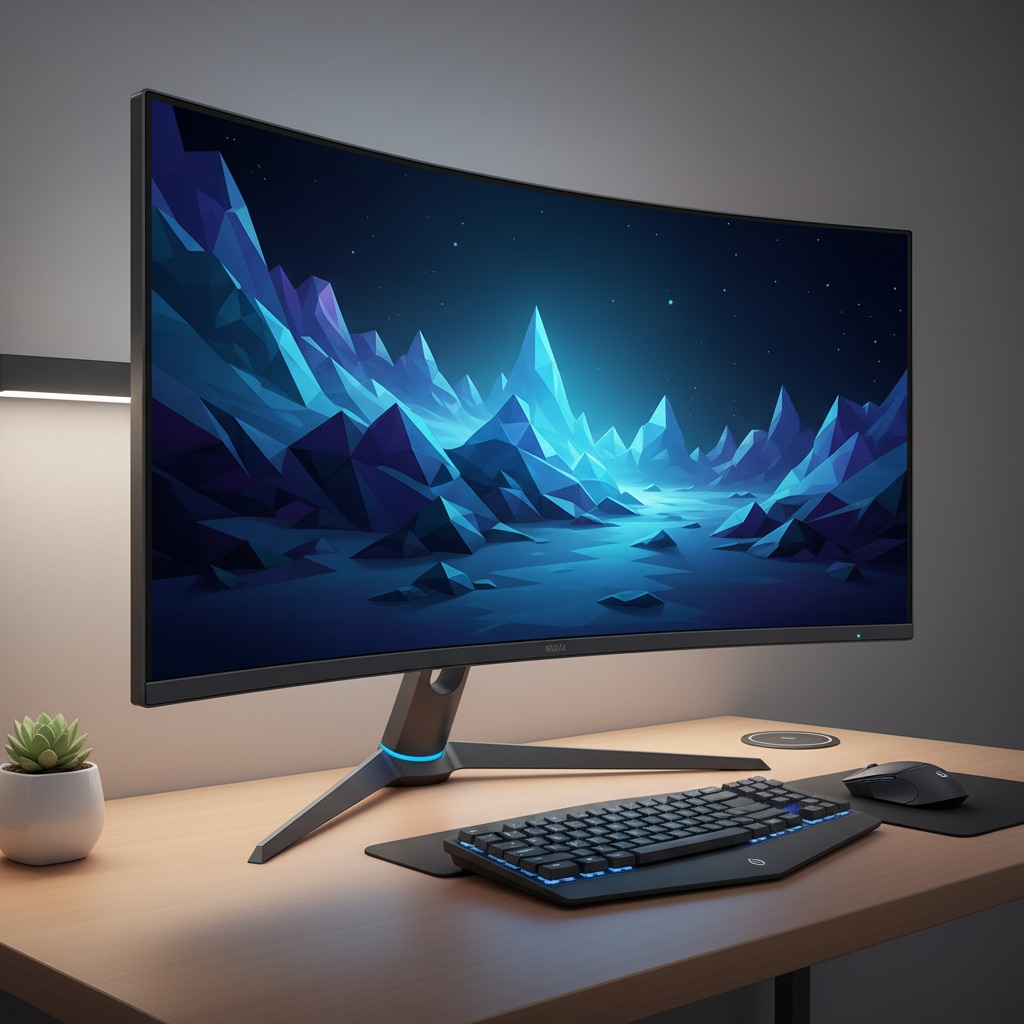
That closer distance is also what makes the curve functionally useful rather than cosmetic. On a wide monitor, a curve keeps the edges of the screen roughly the same distance from your eyes as the center, instead of the edges falling away into your peripheral vision the way they do on a flat wide panel. That’s a genuine ergonomic difference, not just a look.
Gaming Specifically Rewards the Curve
Beyond general viewing comfort, curved screens map onto specific gaming use cases in a way that has no real TV equivalent. Racing and flight simulation are the clearest case. Sehdev noted that “folks that are getting very heavy into simulation gaming with things like Gran Turismo or Flight Simulator… want curved screens.” The likely reason, based on what a curve actually does optically, is the wraparound field of view adding to the sense of speed and spatial awareness those genres depend on, though that specific mechanism is inference rather than something Sehdev stated directly.
Competitive shooters benefit differently: keeping the whole screen at a consistent distance means less time and eye movement needed to register something happening at the edge of your vision, which matters when reacting a fraction of a second faster is the entire point.
Curved shape is also close to mandatory once a monitor gets wide enough. Extreme ultrawides like the 55-inch Samsung Odyssey Ark would be genuinely uncomfortable to use flat; a screen that size laid out straight puts its far edges meaningfully farther from your eyes than its center, which is exactly the distortion a curve exists to cancel out.
It’s Not Only About Gaming
The same wide-screen, single-viewer, close-distance combination that makes curves work for gaming shows up outside games too, even though that’s the use case getting most of the attention. Anyone running a wide monitor for spreadsheets, multiple windows side by side, or video editing is sitting in the exact same setup a gaming curve is designed for: one person, close range, a screen wide enough that flat edges would sit noticeably farther from their eyes than the center.
The curve doesn’t know or care whether what’s on screen is a race track or a spreadsheet; it’s correcting for eye-to-screen distance, which is a physical fact of the setup, not a gaming-specific feature.
That’s worth knowing if a “gaming monitor” label has ever made a curved ultrawide feel like the wrong purchase for someone who mostly does work on it. The same geometry that helps a sim racer track the road edges helps anyone tracking a spreadsheet column at the far side of a 34-inch-plus display.
Is the Cost Premium Worth Paying
Where a curved panel does cost more than an equivalent flat one, the question worth asking is the same one that undid curved TVs: what is that premium actually buying, and for whom. On a TV, it bought a feature that made the picture worse for anyone not sitting dead center, on a screen most households watch as a group.
On a sufficiently wide monitor used by one person sitting close, the same premium buys a real, felt reduction in eye strain and peripheral distortion, not a hidden tradeoff waiting to show up the moment someone else glances at the screen.
That’s the practical test worth applying before paying the premium: would a second viewer, sitting off to the side, actually lose picture quality the way they would on a curved TV? On a personal monitor, the honest answer is usually that there’s no second viewer to worry about in the first place, which is exactly the condition under which the curve stops being a compromise and starts being a genuine upgrade.
What This Means When You’re Choosing
None of this makes curved automatically the right choice for every monitor purchase; it explains specifically when the curve is doing real work versus when it’s just following a trend. A curve earns its keep when you’re sitting close, alone, and using a screen wide enough that its edges would otherwise sit noticeably farther from your eyes than the center; ultrawide and super-ultrawide monitors are the clearest case.
It matters far less on a narrower standard monitor, where the edges are never that far from center distance in the first place, so the curve has much less distortion left to correct.
The TV history is the useful sanity check either way: the same curve that flopped in the living room wasn’t a bad idea in general, it was a good idea applied to a viewing situation it was never suited for. Checking whether your own setup, distance, and screen width actually match the situation curves are good at is a better filter than just going by whichever shape looks more premium on a store shelf.
*Source: Engadget — “Why curved TVs failed but curved gaming monitors thrived”*
Bottom Line
A curved monitor makes sense for single users sitting close to ultrawide screens where flat edges would sit farther from the eyes. Before buying, measure your typical viewing distance and confirm you’ll be the only viewer to ensure the premium reduces eye strain rather than creating off-center compromises.