Meta Ray-ban Smart Glasses: Key Takeaways
- The Meta Ray-Ban smart glasses lineup now offers three distinct tiers priced at $299, roughly $379, and $799, each targeting different buyers.
- The core Meta Ray-Ban smart glasses tier around $379 includes a 12-megapixel camera, five microphones, open-ear speakers, and built-in Meta AI for hands-free queries.
- The $799 Meta Ray-Ban smart glasses display tier adds a lens-embedded screen and a neural wristband for gesture control, but battery life runs roughly six hours per charge.
- Privacy concerns persist with camera-equipped models despite LED indicators and mandatory updates that disable recording if the light is obstructed.
Smart glasses spent years as a niche category defined mostly by Google Glass’s failed launch and a handful of camera-only novelty products. Meta has spent 2025 and 2026 turning that into an actual tiered product line, with three distinct price points, $299, roughly $379, and $799, each aimed at a genuinely different buyer rather than just being the same device at different discount levels. It’s worth understanding what separates them before assuming the cheapest or most expensive option is automatically the right one.
Table of Contents
The Entry Tier: Starting at $299
Meta’s newest, lowest tier starts at $299 and is aimed squarely at bringing the smart glasses category to a wider, more price-sensitive audience, following the same playbook of using an aggressive entry price to build adoption before upselling toward the higher tiers. This tier trades away the more advanced camera and sensor packages of the higher-priced models in exchange for a genuinely accessible starting point, positioned as Meta’s answer to “smart glasses” being seen as a $700-plus category exclusively.
The Core Tier: Ray-Ban Meta Gen 2 at Around $379
The Ray-Ban Meta Gen 2 sits in the middle, starting around $379, and represents what’s become Meta’s core, most fully-featured non-display product. It includes a 12-megapixel camera, a five-microphone array for calls and voice commands, open-ear speakers, and Meta AI built directly into the glasses for hands-free queries, photo identification, and translation.
This is the tier built for someone who wants a fully capable camera-and-AI wearable without paying for the display hardware in the top tier, and it’s the closest match to what most people picture when they think “AI glasses” as of 2026.
The Display Tier: Meta Ray-Ban Display at $799
The top tier, Meta Ray-Ban Display, costs $799 and is the first Ray-Ban model with an actual screen built into the lens rather than audio and camera functionality alone. The display is a 600-by-600-pixel, full-color panel embedded in the right lens, running at a 90Hz refresh rate with up to 5,000 nits of brightness and a 20-degree field of view.
It can show text messages and video calls through WhatsApp and Messenger, turn-by-turn navigation, a live camera viewfinder, real-time captions and translations, and what’s currently playing on Spotify, functionally turning the right lens into a small heads-up display for notifications and navigation without needing to pull out a phone.
The Neural Band Is What Makes the Display Tier Actually Usable
The $799 price includes something the lower tiers don’t: the Meta Neural Band, a wristband that reads electrical signals from forearm muscles using sEMG (surface electromyography) technology to detect finger and hand movements. That’s what makes the display tier practically usable, since swiping through notifications or navigating a menu via a pinch gesture on your wrist is a meaningfully different, more discreet interaction model than tapping a touchpad on the glasses’ frame the way the lower tiers work.
The Neural Band runs up to 18 hours of battery life on its own, carries an IPX7 water rating, and provides haptic feedback, essentially functioning as a separate, purpose-built controller device bundled into the display tier’s price rather than an optional accessory.
What the Cameras and Battery Life Look Like
Across the higher tiers, the camera specs are genuinely capable rather than a token feature: a 12-megapixel ultra-wide sensor recording video at 3K resolution and 30fps, with 3x digital zoom. Battery life is the more honest tradeoff to know about upfront: the Display model runs roughly six hours on a charge under mixed usage, with its charging case extending that to about 24 hours of total usage across a day.
That’s a real limitation worth planning around, closer to a smartwatch’s daily-charge rhythm than a pair of ordinary glasses that simply sit on your face without a battery to manage.
The Privacy Controversy Worth Knowing About Before Buying
Camera-equipped glasses have a real, documented privacy problem worth understanding regardless of which tier is under consideration. Every pair includes a white LED that flashes when a photo or video is being captured, meant to signal to bystanders that recording is happening, and Meta states it cannot be turned off through the glasses’ normal settings. In practice, that safeguard has proven weaker than intended: the light can be hard to notice in daylight, isn’t well understood by many bystanders who see it, and a market of aftermarket modders emerged specifically selling cheap stickers and modifications to block or disable it, enabling what’s been reported as a genuine “stealth mode” for covert recording.
Meta has since pushed a mandatory software update that shuts off the camera entirely if it detects the indicator LED has been tampered with or physically obstructed, plus a requirement that recording only start via a manual button press or a spoken “Hey Meta” command rather than passively. That’s a real, still-evolving problem rather than a solved one, and it’s worth factoring into a purchase decision as a genuine social and legal consideration, not just a product spec, particularly for a buyer who’ll be wearing camera-equipped glasses regularly around other people who haven’t consented to being recorded.
Availability Is Still Genuinely Limited
The Display tier isn’t broadly available the way a typical consumer electronics launch would be. It shipped starting September 30, 2025 in limited quantities, sold initially only in person at a small set of U.S. retailers, Best Buy, LensCrafters, Sunglass Hut, and Ray-Ban’s own stores, rather than through open online ordering.
International availability was set to expand to Canada, France, Italy, and the UK only in early 2026. Anyone specifically wanting the Display tier should expect to check in-store stock directly rather than assume standard online purchase availability, a real, practical constraint separate from the price itself.
Matching the Tier to the Actual Use Case
A few honest ways to think through which tier fits a specific buyer, rather than defaulting to the most expensive option:
- If the appeal is mainly hands-free photos and video plus a built-in AI assistant, the ~$379 Ray-Ban Meta Gen 2 covers that completely without paying for display hardware that adds real bulk, weight, and a shorter battery life on top of the base experience.
- If notifications, navigation, and messaging without pulling out a phone are the specific draw, the $799 Display tier is the only one of the three that actually delivers that, since the lower tiers have no screen at all.
- If budget is the primary constraint and the goal is simply trying the category, the $299 entry tier is built exactly for that use case, with the explicit tradeoff of a less capable camera and sensor package.
- If all-day wear without battery anxiety matters most, it’s worth weighing that the Display tier’s roughly six-hour battery life is a real daily-management task, not a minor footnote, before committing to the top tier specifically for its always-available display.
The Bigger Pattern Worth Watching
Meta’s three-tier structure is a real signal about where the company is betting the smart glasses category goes next: not a single product trying to be everything, but a deliberately segmented lineup mirroring how smartphones and smartwatches already sell, entry, mid, and premium, each targeting a distinct buyer rather than a single one-size-fits-all device. Whether that structure holds as the technology matures, or converges back toward one dominant tier the way some other wearable categories have, is worth watching over the next product cycle, but for a 2026 buyer trying to pick between the three, the practical differences above (camera-and-AI-only, versus a full in-lens display with a neural wristband, versus an accessible entry point) are the deciding factor, not just how much each option costs on its own.
Sources: Meta’s own product announcements, specifications, and pricing pages for Ray-Ban Meta Gen 2 and Meta Ray-Ban Display, cross-checked against Road to VR’s and TechCrunch’s 2026 reporting.
Bottom Line
The Meta Ray-Ban smart glasses line spans three tiers with distinct features, so match your choice to whether you prioritize AI-assisted capture, a heads-up display, or a low-cost entry. Visit a listed retailer to try the display model in person before committing to the $799 tier.
Related Reading
- The Oura Ring 5 Costs More Than $399. Here’s the Real Number.
- Why Budget Phone Batteries Just Jumped Past 7,000mAh
- Every Laptop Ad Says ‘AI PC’ Now. Here’s What That Actually Buys You.
Further reading: Smartglasses (Wikipedia).
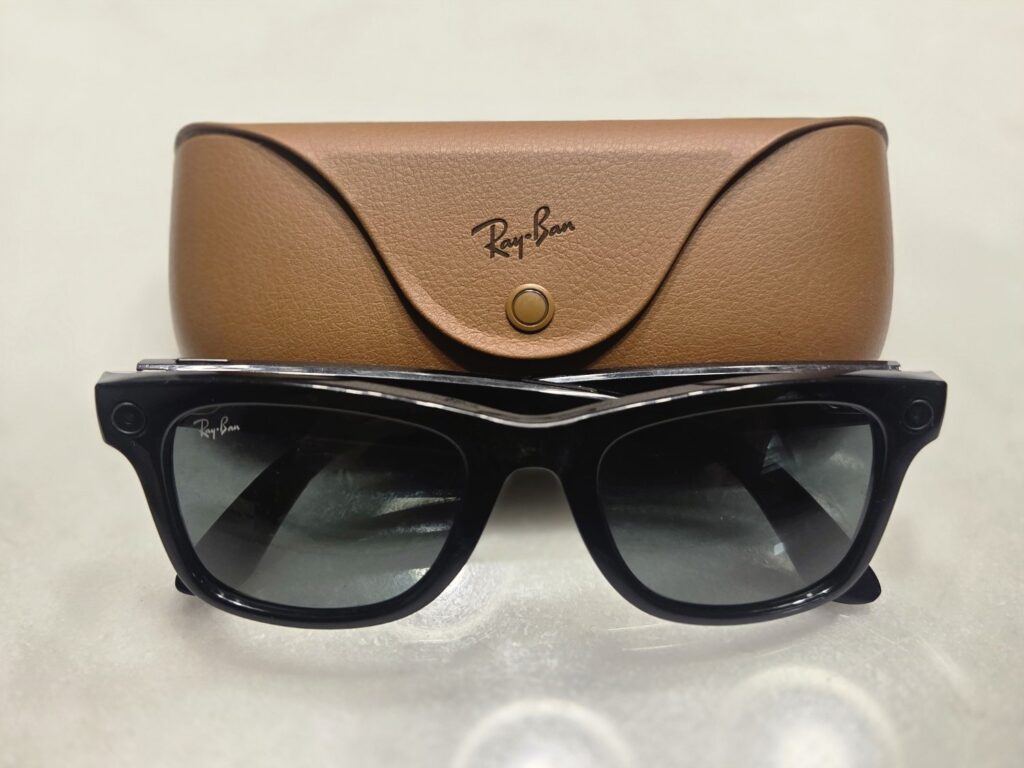
Photo credit: “Ray-Ban Meta Gen 1 smart glasses with charging case” by CCadio, licensed CC BY 4.0 (https://creativecommons.org/licenses/by/4.0/). Source: https://commons.wikimedia.org/w/index.php?curid=192759514