Smart scales promise body fat percentage, muscle mass, and other detailed body composition numbers from a simple step onto a bathroom scale, but understanding what’s actually being measured, and how easily that measurement can shift for reasons unrelated to any real change in your body, matters more to using one well than trusting the number displayed after each weigh-in.
Table of Contents
How Smart Scales Work
Nearly all consumer smart scales use bioelectrical impedance analysis (BIA), sending a small, imperceptible electrical current through the body and estimating body composition based on how easily that current passes through different tissue types, since fat, muscle, and other tissues conduct electricity differently. That’s a fundamentally different, far less direct method than DEXA (dual-energy X-ray absorptiometry) scanning, the clinical gold standard, which directly images fat, lean tissue, and bone as separate, distinct components using X-ray absorption rather than inferring composition from electrical resistance.
The Real Accuracy Numbers Against DEXA
Consumer smart scales generally land within about 3% to 5% of DEXA scan results for body fat percentage at a population level, a reasonable approximation in aggregate. But that population-level accuracy hides real, meaningful individual variation: one large comparison study found BIA tended to overestimate fat-free mass and underestimate fat mass compared to DEXA across many BMI ranges, with wide enough limits of agreement that researchers concluded BIA and DEXA aren’t interchangeable for assessing any single individual precisely.
A separate validation study comparing several connected smart scales directly against DEXA found body weight measurements were quite accurate, typically under 1 kilogram of error, but fat mass and muscle mass estimates showed considerably larger errors, leading the study’s authors to conclude smart scales shouldn’t replace DEXA scanning for body composition assessment in any clinical or medical context.
Why Hydration Alone Can Move the Number
This is the detail most smart scale owners never learn, and it explains a lot of confusing day-to-day fluctuation in body fat readings that has nothing to do with actual body composition changes. Because BIA measurements depend on how electricity travels through body tissue, and hydration level directly affects that electrical conductivity, simply drinking water can measurably shift a BIA-based body fat reading.
One study found that repeated water doses of 500 milliliters, up to a total of 2 liters, substantially changed BIA-derived body composition estimates in the same person within a short window, despite no actual change in body fat having occurred.
That’s a real, physiologically-grounded reason a smart scale’s day-to-day number can bounce around in ways that feel inconsistent or unreliable if hydration timing isn’t controlled for.
Why Electrode Count Affects Accuracy
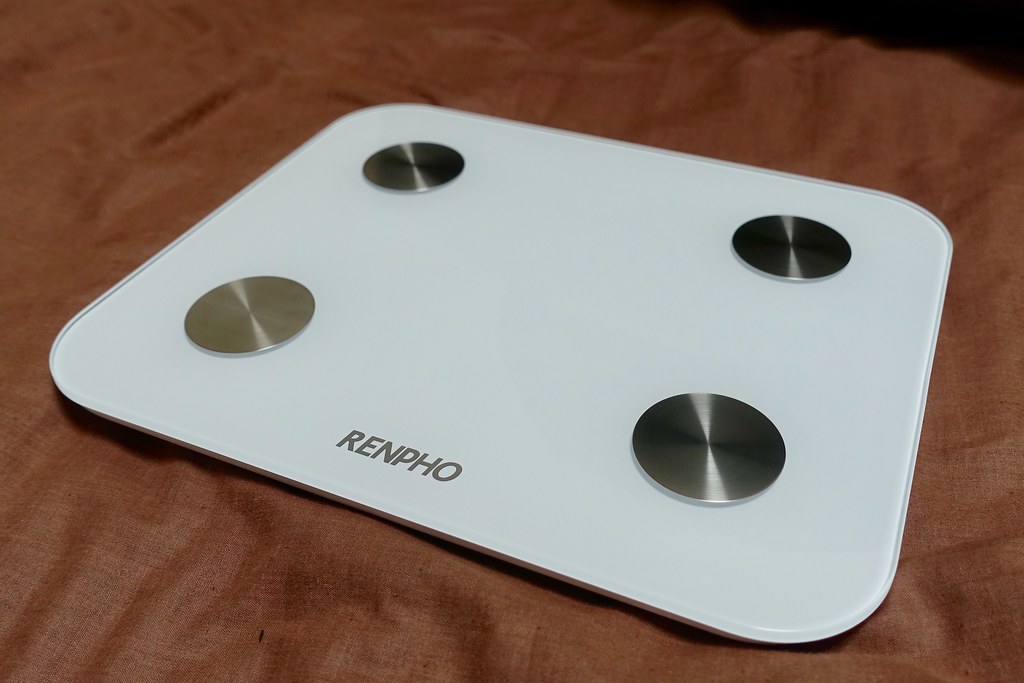
Beyond the general BIA-versus-DEXA accuracy gap, a real, meaningful difference exists between smart scale designs themselves. Standard bathroom smart scales use four electrodes built into the platform you stand on, passing a small current up one leg and down the other, measuring only lower-body impedance and estimating the rest of the body’s composition from that single leg-to-leg reading. An 8-electrode scale adds a separate handle with four more sensors, creating additional circuits running through the arms and torso as well, enabling segmental analysis that measures arms, legs, and trunk independently rather than extrapolating the whole body from legs alone.
That segmental approach delivers meaningfully more detailed and generally more accurate results than a standard 4-electrode platform-only scale, though it’s worth being realistic about the actual improvement: even 8-electrode scales still carry roughly an 8% potential error margin against a true DEXA scan, an improvement over simpler models but still a real estimation rather than a medical-grade measurement.
Getting Genuinely Useful, Consistent Readings
Research-backed measurement protocols point to specific conditions worth replicating consistently to get readings that are at least comparable to each other over time, even if not perfectly accurate in an absolute sense: taking measurements when not dehydrated, waiting at least 4 hours after eating or drinking, using the bathroom beforehand, and avoiding measurement within 12 hours of intense exercise, since BIA readings only stabilize roughly an hour after physical activity.
It’s also worth knowing that different BIA devices shouldn’t be used interchangeably for tracking the same trend over time, since each manufacturer’s specific algorithm and electrode configuration produces its own internally consistent but not necessarily cross-comparable set of numbers.
A Safety Note Worth Knowing
Bioelectrical impedance scales carry one genuine, specific caution: the small electrical current involved is generally considered contraindicated for anyone with an implanted pacemaker or defibrillator, since it circulates a low-level electrical signal through the body that could potentially interfere with how such a device functions, though this remains an area some research continues to investigate further rather than a fully settled question.
For pregnancy, current research indicates BIA itself carries no known safety risk, but the accuracy of the fat mass reading specifically shouldn’t be trusted during pregnancy, since the body’s fluid distribution changes in ways the standard BIA algorithm isn’t calibrated to account for.
What a Smart Scale Is Good For
Given all of the above, the honest, well-supported use case for a consumer smart scale isn’t precise, absolute body composition measurement, it’s consistent trend tracking over time. Used the same way, under the same conditions, at the same time of day, a smart scale becomes a genuinely reliable tool for observing whether body composition is trending in a particular direction over weeks and months, even if the specific percentage displayed on any single day isn’t a precise, clinically accurate number on its own.
That reframing, trend tool rather than diagnostic instrument, is the difference between a smart scale being a genuinely useful part of a fitness routine and being a source of confusing, seemingly contradictory numbers that erode trust in the device entirely.
A Practical Buying and Usage Checklist
A few concrete steps worth following regardless of which specific smart scale is being considered or already owned:
- Weigh in at the same time of day under the same conditions, ideally first thing in the morning before eating or drinking, to minimize the hydration-driven fluctuation described above.
- Track the trend line over weeks, not the single-day number, treating any one reading as a noisy data point rather than a precise measurement in isolation.
- Stick with one specific device for ongoing tracking rather than switching between different smart scales or comparing readings across brands, since each device’s algorithm produces its own internally consistent but not cross-comparable numbers.
- Consult a doctor before regular use if you have an implanted pacemaker or defibrillator, given the documented, if still actively studied, concern about electrical interference with cardiac devices.
- Consider an 8-electrode model with handles specifically if segmental data (arm, leg, and trunk composition separately) is genuinely useful for your goals, since that added detail is the real accuracy advantage over a standard platform-only scale, rather than assuming a higher price alone guarantees better numbers.
None of this makes a smart scale a bad purchase; it makes it a genuinely useful tool once its actual role, tracking direction and trend rather than delivering a clinically precise snapshot, is understood correctly from the start.
Sources: Aggregated 2026 smart scale accuracy reporting from BodySpec and Wearable Wellness Guide, cross-checked against published bioelectrical impedance research.
Related Reading
- The Robot Vacuum Spec That Actually Matters Isn’t Suction Power. It’s Whether It Can See in the Dark.
- The Oura Ring 5 Costs More Than $399. Here’s the Real Number.
- Passkeys Were Supposed to Kill Passwords by Now. Here’s Why They Haven’t.
Further reading: Bioelectrical impedance analysis (Wikipedia).
Photo credit: “RENPHO DIGITAL SMART SCALE” by masatsu, licensed BY-SA (https://creativecommons.org/licenses/by-sa/2.0/). Source: https://www.flickr.com/photos/30447586@N00/48169309732