Robot vacuum marketing tends to lead with suction power and battery life, but the spec that actually determines whether a robot vacuum cleans reliably, or gets stuck under furniture and misses whole sections of a room, is the navigation technology underneath it: LiDAR or camera-based vSLAM. The two work fundamentally differently, and neither one is simply better across the board.
Table of Contents
How LiDAR Navigation Actually Works
LiDAR functions like a small, continuously spinning laser scanner mounted on top of the robot, emitting light pulses and measuring how long they take to bounce back off nearby objects to build a precise 3D map of the space. That laser-based measurement doesn’t depend on ambient light at all, which is the technology’s single biggest practical advantage: a LiDAR robot vacuum maps and navigates a room the same way at 2 AM in complete darkness as it does at noon with the blinds open.
Because the resulting map is a consistent, accurate spatial model, LiDAR robots can plan efficient, straight-line cleaning routes, avoid re-cleaning areas they’ve already covered, and reliably recognize when a room’s coverage is actually complete.
How Camera-Based Navigation Works Differently
Camera-based navigation, often called vSLAM, relies on one or more onboard cameras capturing visual features of the environment, then comparing successive images to estimate the robot’s position and build a map from that visual data. This approach depends meaningfully on ambient light and visual contrast in the room, meaning a dark room, a room with dim or inconsistent lighting, or large stretches of plain, low-contrast flooring can all degrade a camera-based robot’s ability to map and navigate accurately, a real limitation LiDAR simply doesn’t share.
Where Camera Navigation Genuinely Wins
None of this makes camera-based navigation strictly worse, and it’s worth being specific about where it has a real advantage: object recognition. A camera can identify and react to specific obstacles in a way a laser distance-scanner alone cannot, cords, socks, shoes, small toys, and pet waste among the commonly cited examples. For a household with pets, kids, or generally more day-to-day floor clutter, a camera system’s ability to actually recognize what an obstacle is, rather than simply detecting that something is in the way, can mean the difference between a robot that navigates around a genuine hazard cleanly and one that either gets stuck on it or smears it across the floor.
The Hybrid Approach Premium Models Are Moving Toward
The clearest sign that neither technology alone is the complete answer is the direction premium robot vacuums have moved: combining both. Models like the Roborock S8 Pro Ultra and Ecovacs Deebot X2 Omni use dual-sensor fusion, LiDAR for the structural, room-level mapping and cameras layered on top specifically for identifying and reacting to individual obstacles.
That combination is designed to capture LiDAR’s lighting-independent mapping reliability while adding the object-level awareness camera systems bring, and it’s a meaningfully more capable, if more expensive, approach than either sensor type running alone.
Why the Price Gap Exists
LiDAR sensors generally cost more to manufacture than camera-based systems, which is part of why camera-only robot vacuums often occupy a lower price tier than comparable LiDAR models. That said, a camera-only robot typically needs more repeated passes to fully update its map after furniture gets rearranged, since it’s rebuilding its spatial understanding from a less consistent, lighting-dependent data source each time, a real efficiency cost that partially offsets the lower purchase price over time.
True hybrid systems combining both sensor types remain the most expensive tier of the category, reflecting the added hardware and processing required to fuse two different kinds of sensor data into one navigation system.
Why Mapping Quality Matters Beyond the Single Cleaning Session
The navigation technology’s accuracy doesn’t just affect how well a single cleaning run goes; it directly determines how well multi-floor memory and customization features work over time, features that have become standard on capable 2026 models. Most current higher-end robot vacuums store four to five complete floor plans, each retaining its own room divisions, no-go zones, and cleaning schedules, and the robot identifies which floor it’s on from its own scan data rather than requiring manual selection every time.
Virtual boundaries set to block off stair edges, delicate rugs, or a pet’s feeding area persist across power cycles and recharges, meaning that setup work only has to be done once per floor rather than redone repeatedly.
A navigation system with weaker, less consistent mapping accuracy, the exact limitation camera-based vSLAM can run into under inconsistent lighting, makes these persistent, precise virtual boundaries meaningfully less reliable, since the underlying map they’re anchored to is itself less consistent from one cleaning session to the next.
Matching the Technology to Your Actual Home
A few honest, home-specific questions worth answering before choosing:
- Do you run the vacuum overnight or in rooms with blinds regularly closed? If so, LiDAR’s lighting-independent mapping is a genuinely meaningful advantage rather than a marketing footnote, since a camera-based robot will struggle in exactly that scenario.
- Do you have pets, small children, or a household that regularly leaves cords, shoes, or small items on the floor? Camera-based object recognition, or a hybrid system that includes it, addresses a real, recurring problem that LiDAR-only navigation doesn’t solve on its own.
- Is budget the primary constraint and your home has consistent lighting and relatively few floor obstacles? A camera-only model at a lower price point is a reasonable match for that specific situation, without paying for LiDAR’s dark-room advantage if it isn’t likely to be used that way.
- Do you want the best of both, and the budget allows for it? A hybrid LiDAR-plus-camera model like the two named above is the closest current option to solving both the lighting and obstacle-recognition problems in one device, at a real price premium over either single-sensor approach.
A Third Sensor Type Worth Recognizing on a Spec Sheet
Beyond LiDAR and camera-based vSLAM, some current robot vacuums also incorporate structured light or time-of-flight (ToF) sensors, a distinct depth-sensing approach that projects a light pattern and measures how it deforms across surfaces to judge distance and shape, separate from both a spinning laser scanner and a standard camera. This is typically used to supplement rather than replace one of the two primary navigation approaches described above, most often paired with a camera system to improve close-range obstacle detection in low light without needing full LiDAR hardware.
Seeing “ToF sensor” or “structured light” on a spec sheet alongside a camera-based navigation claim is worth reading as a partial mitigation of the camera system’s lighting dependency, not a full substitute for LiDAR’s room-scale, lighting-independent mapping.
The Bottom Line
For most households, LiDAR is the more consistently reliable core navigation technology, since it maps accurately regardless of lighting and produces more efficient, complete cleaning coverage as a result. Camera-based navigation solves a real, different problem, recognizing what specific obstacles actually are, that LiDAR alone doesn’t address.
Neither spec should be evaluated in isolation from the other; the honest answer for a lot of buyers is that the ideal setup increasingly means both, and the industry’s shift toward hybrid sensor fusion in premium models reflects exactly that.
Sources: Aggregated 2026 robot vacuum navigation reporting from Narwal Robotics, Dreame, and RTINGS.com, cross-checked across multiple sources.
Related Reading
- Wire-Free Robot Mowers Don’t Need a Buried Cable. They Still Need to Match Your Yard.
- The Real Cost of Smart Home Subscriptions — and What to Buy Instead
- Every Laptop Ad Says ‘AI PC’ Now. Here’s What That Actually Buys You.
Further reading: Robotic vacuum cleaner (Wikipedia).
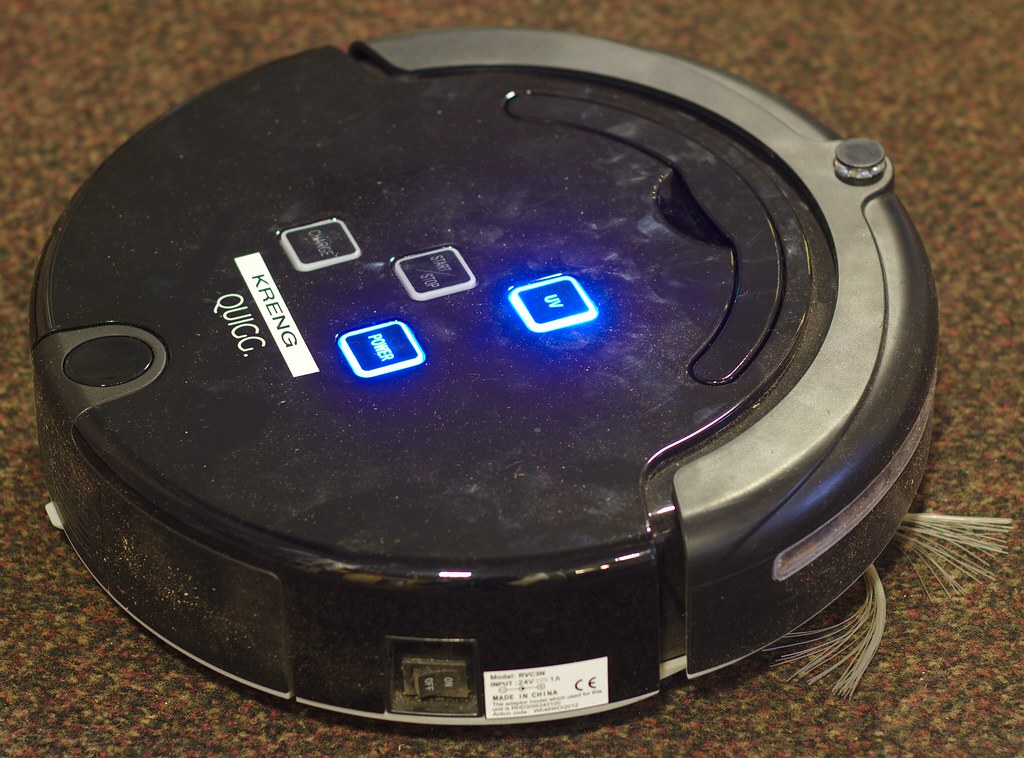
Photo credit: RVC3N Robotic Vacuum Cleaner ‘Kreng’ on the job by dvanzuijlekom, licensed BY-SA (https://creativecommons.org/licenses/by-sa/2.0/). Source: https://live.staticflickr.com/8508/8499549941_717873b9cd_b.jpg