Vinyl record sales have kept climbing for over a decade, and the format’s genuine revival has brought a flood of budget turntables designed to look appealing on a shelf more than to actually play records well. A handful of components determine whether a record player treats records gently and sounds decent, or wears down a record collection a little more with every play. Understanding a few real specs before buying prevents the most common beginner mistake in the category.
Table of Contents
The Cheapest All-in-One Turntables Can Damage Records
Many budget suitcase-style and all-in-one turntables use a cartridge with excessive tracking force, meaning the needle presses down on the record harder than it should, along with a low-quality stylus (the needle tip itself). Combined, this genuinely accelerates record wear with every play, a real and well-documented issue in the format’s revival rather than audiophile snobbery.
This doesn’t mean an entry-level turntable is automatically a bad choice, but it does mean checking tracking force and cartridge quality specifically, rather than assuming any record player at any price treats records the same way.
What a Cartridge and Stylus Actually Do
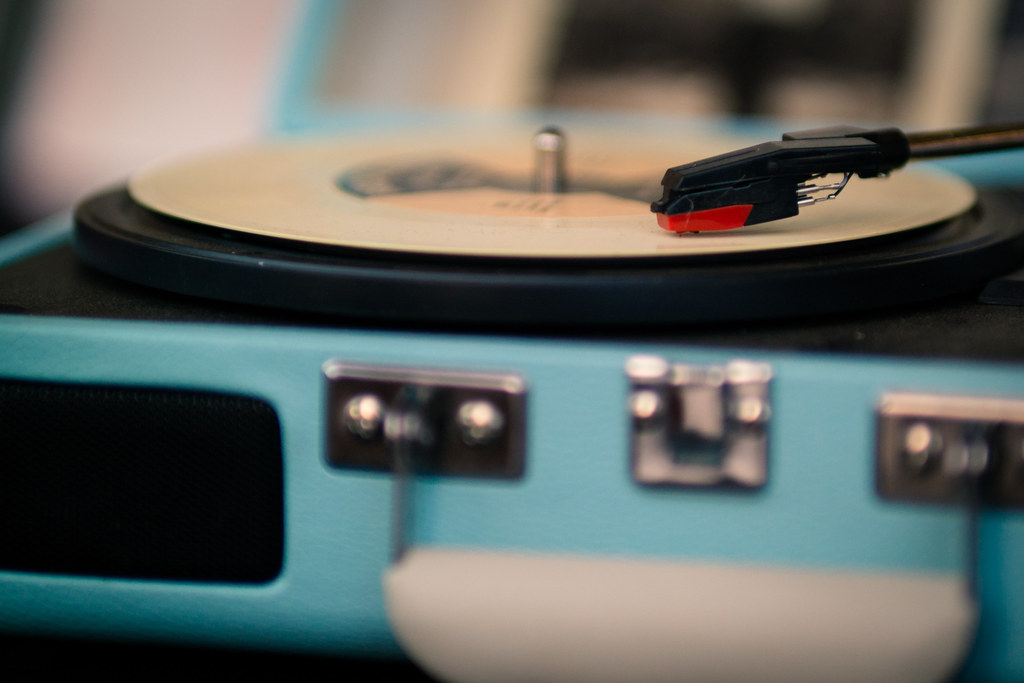
The cartridge holds the stylus, the physical needle that sits in a record’s grooves and converts the groove’s physical shape into an electrical audio signal. This is the single component most responsible for both sound quality and how gently a record is treated, and it’s also a wearable, replaceable part on a decent turntable, meaning a stylus can be swapped for a better one or replaced when worn without buying an entirely new turntable.
A turntable with a fixed, non-replaceable cartridge is a real limitation worth knowing about before buying, since it locks in sound quality and record-wear characteristics permanently.
Belt-Drive vs. Direct-Drive
A belt-drive turntable spins the platter using a rubber belt connected to a separate motor, which isolates the platter from motor vibration and generally produces quieter, cleaner sound, at the cost of the belt being a wearable part that eventually needs replacement. A direct-drive turntable connects the motor directly to the platter, spinning up faster and holding speed more precisely under stress, which is why DJ turntables are almost universally direct-drive.
For home listening rather than DJ use, belt-drive is generally the better default; direct-drive matters specifically for scratching or precise start-stop control.
Does a Turntable Need a Separate Phono Preamp?
A turntable’s output signal is much weaker and shaped differently than a standard audio signal, and needs a phono preamp to boost and correctly equalize it before it can play through regular speakers or a receiver. Some turntables include a built-in phono preamp with a switch to turn it on or off; others require an external one.
Before buying speakers or an amplifier to pair with a record player, it’s worth confirming whether phono preamplification is already built into one of the components, since connecting a record player without one anywhere in the signal chain, or with one twice, both cause real problems.
Bluetooth Turntables: A Real Convenience Trade-Off
Turntables with built-in Bluetooth let a record play through wireless speakers or headphones without any wired connection, which is genuinely convenient. The trade-off is that Bluetooth’s compression and inherent latency work against the specific appeal of vinyl’s analog signal path, meaning the audio benefit vinyl is often bought for is partly undone by converting it back to a compressed wireless signal.
For background listening this is a reasonable compromise; for a listener specifically chasing vinyl’s sound character, a wired connection preserves more of what makes the format distinct.
A Practical Buying Approach
- Check the cartridge’s tracking force and confirm it’s replaceable before buying, especially at the lower end of the price range, since this is the spec most tied to actual record wear.
- Choose belt-drive for home listening unless scratching or DJ-style use is a specific goal.
- Confirm phono preamp coverage somewhere in the setup, either built into the turntable or as a separate unit, before connecting to speakers.
- Treat Bluetooth as a convenience feature, not a sound-quality one, and use a wired connection when audio fidelity is the actual priority.
The Honest Trade-Off
A genuinely good entry-level turntable exists at a reasonable price, but the category is crowded with appealing-looking, poorly-engineered options that wear down the exact records buyers are excited to collect. Checking cartridge quality and tracking force specifically, rather than shopping by appearance or price alone, is the difference between a record player that respects a record collection and one that quietly degrades it.
Related Reading
- Your Gaming Headset Looks Unprofessional on Zoom. Here’s What Actually Fixes That.
- Most Soundbars Advertising Dolby Atmos Don’t Have a Single Speaker Pointed Up. Here’s How to Tell the Real Ones Apart.
- That Projector’s ‘3,000 Lumens’ Might Actually Be 180. Here’s the Number That Matters.
Sources: Audio-Technica: how to select a turntable.
Photo credit: “Vinyl Record Player” by nan palmero, licensed BY (https://creativecommons.org/licenses/by/2.0/). Source: https://www.flickr.com/photos/97402086@N00/9759224905