Gaming Headset: Key Takeaways
- A gaming headset provides superior microphone quality through dedicated boom mics with noise-cancellation processing built for voice clarity.
- Gaming-grade wireless earbuds address the gaming headset’s appearance problem for hybrid workers alternating between video calls and in-person meetings.
- Traditional gaming headset remains the better choice for six-plus daily call hours or professional streaming where microphone quality is paramount.
- The Razer Hammerhead Pro delivers 60-millisecond latency, 30-hour battery life, and two-device pairing for seamless laptop-to-phone switching.
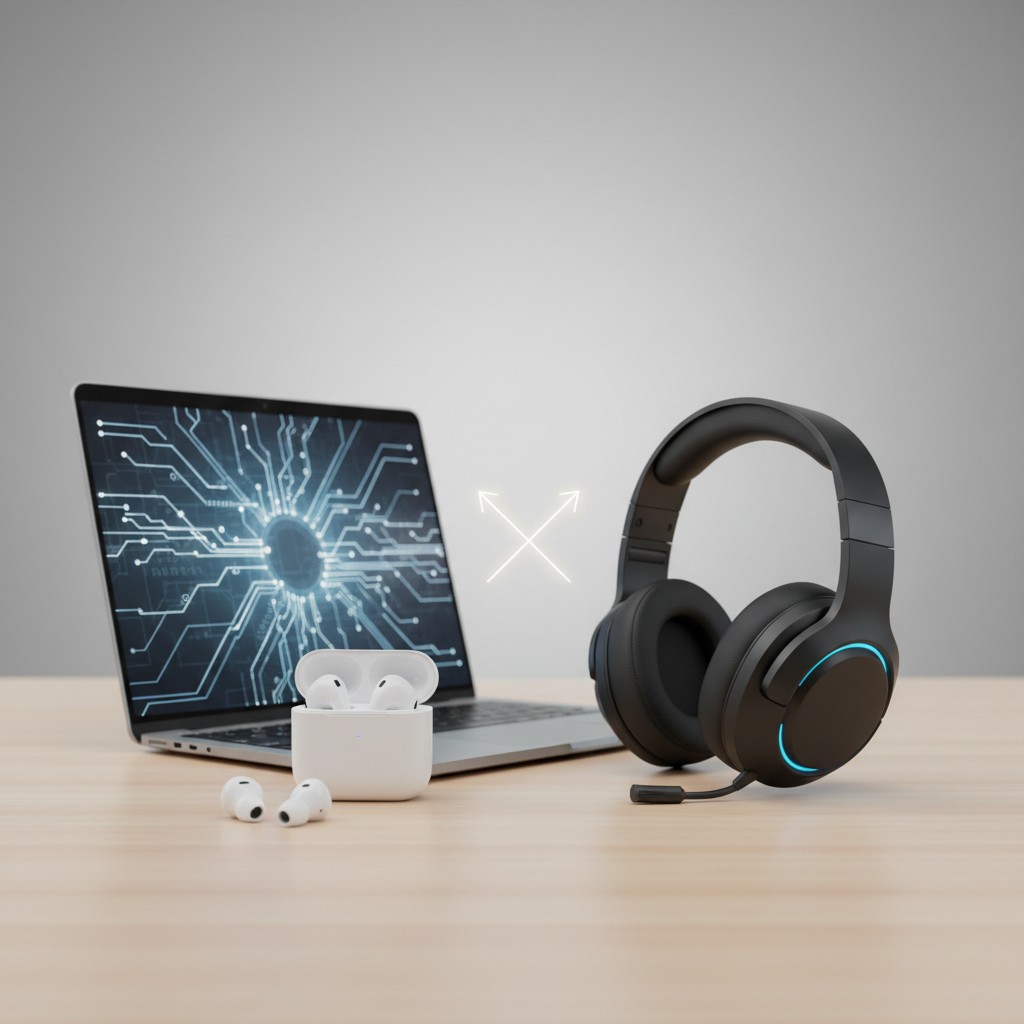
A full-size gaming headset has, by a real margin, the best microphone of anything on a typical desk: dedicated boom mics with noise-cancellation processing built specifically for voice clarity. It also makes a hybrid worker look, in the words of one recent comparison, “like a pilot on Zoom” during the three or four video calls that make up the other half of a typical workday.
Table of Contents
That’s the actual problem a specific category of product, gaming-grade wireless earbuds, is now built to solve, and understanding what they’re compromising to get there matters more than just picking the highest-rated option on a spec sheet.
The Two Failure Modes This Is Solving
Standard wireless earbuds, the kind bought primarily for music and calls, have two problems as a full-time work-and-play device: mediocre microphone quality that becomes obvious the moment a coworker asks “can you repeat that,” and battery life that’s rarely built with an 8-hour workday plus gaming sessions in mind.
Traditional gaming headsets solve both of those, at the cost of looking, and often feeling, like gaming equipment strapped on for a client call. Gaming-branded wireless earbuds are a specific attempt to sit between these two failure modes rather than eliminate either one completely.
What a Real Example Delivers
The Razer Hammerhead True Wireless Pro, usually priced around $79.99, is a concrete case worth walking through because the spec tradeoffs are typical of the category. It uses beam-forming microphone technology with THX certification aimed specifically at voice clarity, delivers 60 milliseconds of latency in its low-latency gaming mode, and gets roughly 30 hours of battery life including the charging case.
It also ships in a plain white (“Mercury White”) colorway specifically marketed as looking like a normal pair of earbuds on a video call rather than obviously gaming hardware, and it supports pairing to two devices at once, which matters for switching between a work laptop and a phone without a manual re-pair each time.
How That Stacks Up Against Non-Gaming Earbuds
Compared against two well-known non-gaming options, the tradeoffs are specific rather than uniform. Sony’s WF-1000XM5, at roughly $328, has stronger noise cancellation and audio fidelity generally, but around 120 milliseconds of latency, double the Hammerhead Pro’s, which is noticeable as audio-visual lag in any fast-paced game. Apple’s AirPods Pro 2, at roughly $247, matches the Hammerhead Pro’s 30-hour case battery life and offers tighter integration with Apple devices, but at 144 milliseconds of latency, it’s built for calls and casual listening, not gaming timing.
Neither the Sony nor the Apple option is a worse product overall; they’re simply optimized for audio quality and ecosystem integration rather than the specific combination (low latency plus call-grade mic plus long battery) a hybrid worker who also games actually needs.
When a Traditional Gaming Headset Still Wins
None of this makes gaming earbuds the universally correct choice. A traditional gaming headset is still the better pick for anyone spending six or more hours a day on calls, anyone who needs the single best possible microphone quality available (a boom mic close to the mouth still outperforms even a good beam-forming earbud in noisy environments), full-time home-office workers who aren’t juggling an office dress code or in-person meetings, and anyone doing professional streaming or content creation where microphone quality is itself part of the product.
For that specific set of use cases, the appearance tradeoff of a headset simply doesn’t apply the same way it does for someone alternating between video calls and in-person meetings during the same week.
The Budget Version of the Same Idea
For anyone convinced by the category but not the $79.99 price point, Razer’s own Hammerhead True Wireless X sits at roughly $74.99 as a lower-tier version of the same concept: gaming-oriented latency and a workday-friendly form factor at a slightly reduced spec level. It’s worth treating as confirmation that this category isn’t a single $80 product but a genuine tier of options, the same way wired gaming headsets exist at multiple price points with the same core design goals.
Comfort for a Full Workday, Not Just a Gaming Session
A gaming session and a workday put different demands on the same piece of hardware. Over-ear headsets, even well-padded ones, tend to generate heat and clamping pressure over several hours that becomes noticeable well before the battery does, which is part of why an all-day hybrid worker often reaches for earbuds regardless of audio quality.
Earbuds solve the heat and clamping problem but introduce their own version of the same fatigue through ear-canal pressure, particularly with silicone tips that don’t fit well; trying multiple tip sizes, which the Hammerhead Pro and most competitors ship with, is worth doing before deciding a specific pair is uncomfortable for long wear, since an ill-fitting tip is a common and fixable cause of exactly that complaint.
Two-Device Pairing Matters More for Hybrid Work Than It Sounds
Simultaneous two-device pairing, supported on the Hammerhead Pro, is easy to treat as a minor convenience feature, but it solves a specific friction point in a hybrid workday: switching from a work laptop during a video call to a phone call or a personal phone notification without a manual disconnect-and-reconnect step, which single-device-pairing earbuds require every time.
For anyone alternating between a laptop and phone dozens of times a day, that difference adds up to a real amount of friction avoided, even though it’s the kind of spec that’s easy to skip over on a product page next to headline numbers like battery life and latency.
Why Beam-Forming Microphones Matter More Outside a Home Office
A hybrid worker isn’t always calling from a quiet room, and this is where the microphone technology, not just the mic’s raw quality, matters. Beam-forming microphones, like the array used in the Hammerhead Pro, use multiple microphone elements to isolate sound coming specifically from the direction of the wearer’s mouth while suppressing sound from other directions, which is a meaningfully different approach than a single omnidirectional mic picking up everything nearby at similar volume.
That distinction is most noticeable exactly where a hybrid worker is most likely to be taking a call from somewhere other than a quiet home office: a coffee shop, an open-plan office, or a shared coworking space, where background conversation and ambient noise are constant rather than occasional. A single-mic pair of standard earbuds in that environment tends to pick up the whole room; a beam-forming pair is built specifically to reduce that problem, which is worth testing with a real call in a genuinely noisy space before assuming any two products with a “noise-cancelling microphone” label perform the same.
What to Check Before Buying
Three things matter more than the marketing copy on any gaming earbuds product page: the actual latency number in low-latency mode (not the general Bluetooth latency, which is usually higher), since anything meaningfully above 60-70ms starts to feel laggy in fast games; whether the “low latency” mode requires a specific dongle or app rather than working automatically over standard Bluetooth, since dongle-dependent modes won’t work with every device; and real battery life under actual use rather than the manufacturer’s best-case number, since gaming audio processing and active call use both drain a battery faster than idle music playback.
None of these show up clearly in a retailer’s bullet-point spec list, and all three are the difference between a pair of earbuds that actually replaces both a gaming headset and a work headset, and one that’s a compromise on both fronts at once.
Bottom Line
Gaming earbuds balance low latency, call-grade microphones, and all-day comfort for hybrid workers who find a gaming headset impractical for office visibility. Test beam-forming mic performance in a noisy environment and verify low-latency mode works without a dongle before purchasing.
Further reading: Original reporting: cutetechgadgets.com.