
Projector Screen: Key Takeaways
- A projector screen reflects light more evenly than a painted wall, preserving contrast and color accuracy.
- A projector screen with gain above 1.0 brightens the image for narrow seating, while lower gain widens the viewing angle.
- An ambient light rejecting projector screen improves contrast in rooms that cannot be fully darkened.
- A fixed-frame projector screen stays flat for consistent image quality, while motorized and portable types trade flatness for flexibility.
A genuinely good projector pointed at a plain painted wall is leaving real picture quality on the table, regardless of how much was spent on the projector itself. A wall’s paint, texture, and slight color tint all measurably affect contrast, color accuracy, and brightness uniformity compared to a purpose-built projector screen, which is engineered specifically to reflect projected light evenly and accurately. The screen isn’t a purely cosmetic accessory; it’s a genuine, measurable part of the actual picture quality equation.
Table of Contents
Screen Gain Explains Why Some Screens Look Brighter Than Others
Screen “gain” measures how much a screen reflects projected light back toward the viewer compared to a theoretical perfectly diffuse reflective surface, with a gain above 1.0 reflecting more light directly back toward the viewing area, making the image appear brighter in that zone, at the cost of a narrower optimal viewing angle where that extra brightness is actually visible. A gain below 1.0 spreads light more evenly across a wider viewing angle at the cost of peak brightness.
Matching screen gain to the actual room layout and typical seating arrangement, wide seating spread favoring lower gain, a narrower, more centered seating area able to take advantage of higher gain, is a real, specific decision worth making rather than defaulting to whichever gain figure sounds highest.
Ambient Light Rejecting Screens Solve a Real, Common Problem
Traditional projector screens are designed for genuinely dark room conditions and perform poorly with any meaningful ambient light in the room, which is why many home projector setups historically required blackout curtains or a dedicated windowless room to look good at all. Ambient light rejecting (ALR) screen material uses a specially engineered surface structure that selectively reflects light coming from the projector’s direction while rejecting much of the light arriving from other angles, particularly from above, such as ceiling lights, genuinely improving contrast and color in rooms with some ambient light present.
This is a real, meaningful technology difference worth prioritizing for anyone unable to fully darken a projector room, not just marketing terminology for a slightly different screen fabric.
Fixed-Frame, Motorized, and Portable Screens Serve Different Needs
A fixed-frame screen, permanently mounted and always in the same flat position, generally delivers the most consistently flat, wrinkle-free surface and the best possible image quality, at the cost of being a permanent fixture that can’t be hidden away when not in use. A motorized retractable screen offers the flexibility to hide the screen when not watching, rolling down from a ceiling or wall-mounted housing, at a real cost premium and a small risk of the screen material not sitting perfectly flat compared to a fixed frame.
A portable, floor-standing or pull-up screen offers the most flexibility and lowest cost, suited to occasional or temporary setups rather than a dedicated home theater space, generally at some sacrifice in flatness and edge uniformity compared to the other two options.
Screen Material and Texture Affect Perceived Sharpness
Beyond gain and ambient light rejection, a screen’s specific material and surface texture can affect perceived image sharpness and the visibility of a projector’s native pixel structure, with certain woven or perforated materials, sometimes used specifically to allow sound from speakers placed behind the screen to pass through, introducing subtle texture that can be visible up close on certain content.
This is a detail worth checking in reviews or in person for anyone highly sensitive to fine image texture, though it’s a secondary consideration behind gain and ambient light performance for most viewers.
A Practical Buying Approach
- Match screen gain to actual room seating width, not simply choosing the highest available gain figure.
- Prioritize an ambient light rejecting screen for any room without full light control, since this addresses a real, common picture quality problem directly.
- Choose a fixed-frame screen for the best possible permanent image quality, a motorized screen for flexibility in a shared-use room, and a portable screen only for occasional or temporary setups.
- Check for perforated or acoustically transparent material specifically if speakers will sit behind the screen, understanding the potential minor texture trade-off.
The Honest Trade-Off
A projector screen is a genuine, measurable contributor to overall picture quality, not an optional accessory layered on top of the projector’s own capability, and skipping a proper screen for a painted wall meaningfully undersells what a good projector can actually display. Matching screen gain and ambient light rejection to the actual room conditions is as important a decision as the projector model itself for anyone serious about home theater picture quality.
Bottom Line
Match the projector screen gain and ambient-light rejection to your actual seating layout and room lighting. Then pick a fixed-frame, motorized, or portable screen that fits your installation permanence.
Related Reading
- That Projector’s ‘3,000 Lumens’ Might Actually Be 180. Here’s the Number That Matters.
- Foldable Laptops Solve a Real Portability Problem. They Also Inherit Every Foldable-Screen Problem.
- A Gaming Chair’s Cushions Go Flat in 2 to 4 Years. A Good Office Chair Lasts a Decade. Here’s What Actually Matters for Your Back.
Sources: BenQ: what is an ambient light rejecting screen.
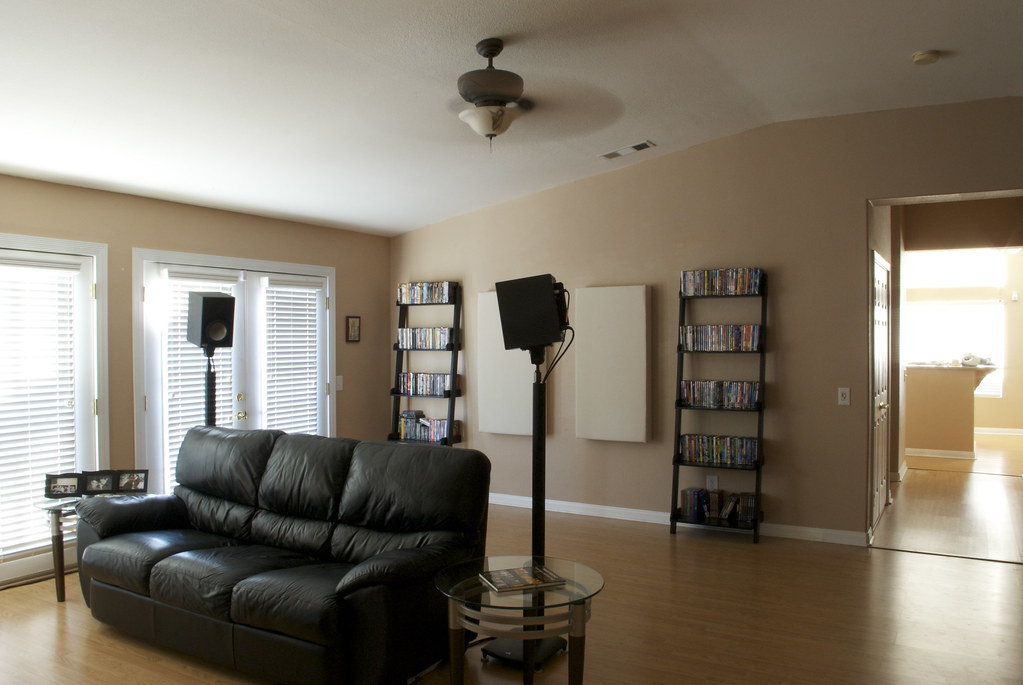
Photo credit: “California Casual Home Theater” by PascalSijen, licensed BY (https://creativecommons.org/licenses/by/2.0/). Source: https://www.flickr.com/photos/8268088@N05/3518285201