Dash cams themselves are legal to own and use everywhere in the United States, but that simple fact obscures the real complexity: where a dash cam can be physically mounted on a windshield, and whether its microphone can legally record audio, are governed by specific, genuinely different rules from state to state. Getting either wrong doesn’t void the footage’s usefulness necessarily, but it can turn a routine dash cam purchase into a traffic citation or, in an audio-consent state, a real legal liability.
Table of Contents
Windshield Mounting Is More Restricted Than Most Buyers Assume
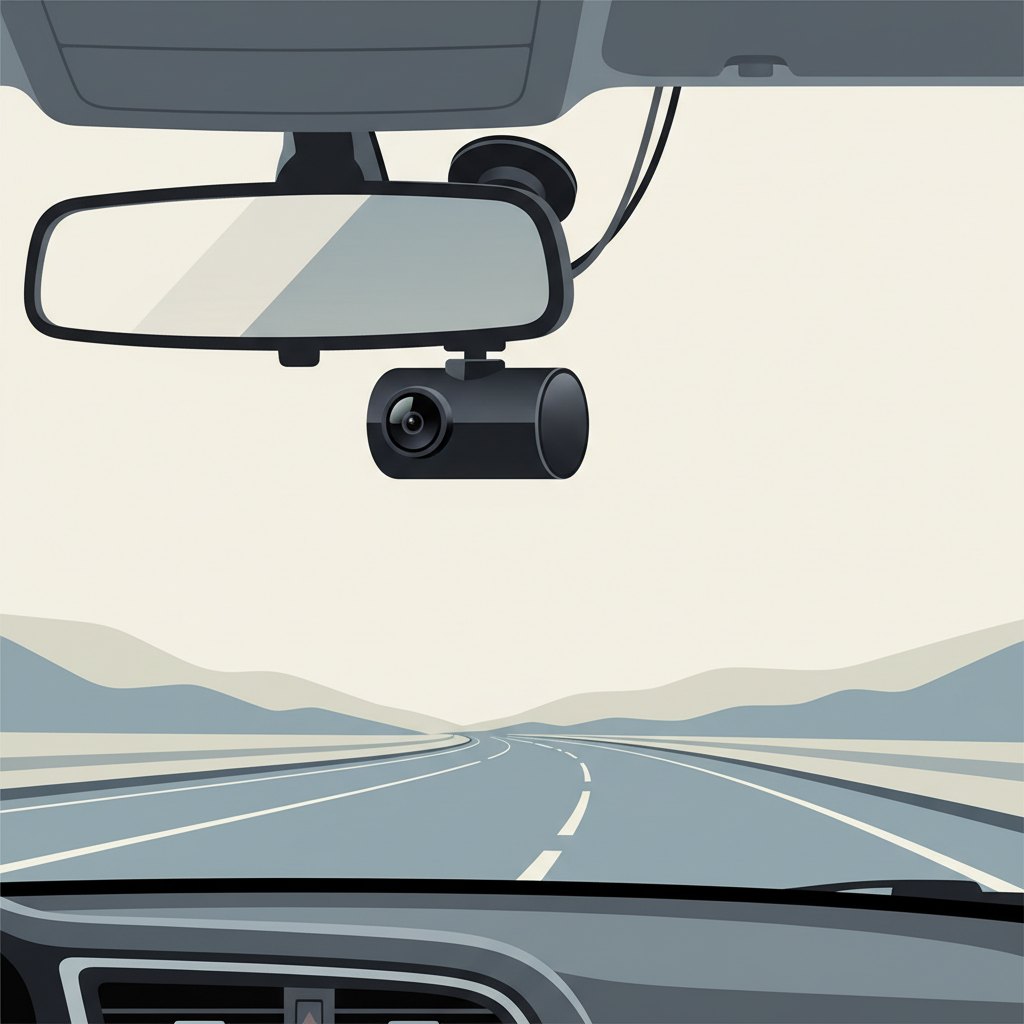
Many states ban or tightly limit anything mounted on a windshield that could obstruct a driver’s clear view, and the specific dimensions allowed vary by state rather than following one universal rule. California permits mounting in exactly three defined zones: a 7-inch square in the lower corner farthest from the driver, a 5-inch square in the lower corner nearest the driver (positioned outside the airbag deployment zone), or a 5-inch square at the very top-center of the windshield.
Illinois takes a different, more restrictive approach entirely, requiring dashboard mounting rather than windshield mounting, capped at five square inches. A dash cam legally mounted in one state’s approved zone could be a citation-worthy obstruction in another, which makes checking a specific state’s actual mounting rule, not just assuming windshield-center is universally fine, a real step worth taking before installation, especially for anyone who drives across state lines regularly.
The Audio Recording Question Is a Real Legal Issue, Not a Technicality
This is the part of dash cam law most buyers overlook entirely, and it carries more serious consequences than a mounting citation. Thirteen states, including California, Illinois, Pennsylvania, Florida, Massachusetts, and Washington among others, require all-party consent before recording audio of a private conversation, meaning every person whose voice could be captured needs to agree to being recorded, not just the driver operating the dash cam. Video-only recording in public spaces like roadways generally doesn’t trigger this requirement, but a dash cam’s built-in microphone capturing in-cabin conversation with passengers is a meaningfully different legal category.
Practical guidance from legal sources in these states includes posting a visible notice in the vehicle and getting verbal acknowledgment from passengers before recording audio, or simply disabling the microphone entirely if that step isn’t practical, an option nearly every dash cam model includes as a menu setting.
What Resolution and Features Matter
Beyond the legal considerations, dash cam video quality has become a real, meaningful spec worth paying attention to rather than treating all “HD” claims as equivalent. Current options span 1080p, 1440p, and 4K resolution, with higher resolutions commanding higher prices but delivering real, practical benefits: capturing a license plate clearly in bright glare or retaining usable color detail after dark is exactly the kind of evidence that matters most in an actual incident, and lower-resolution footage can fail at precisely that job when it’s needed.
Parking mode, which continues recording or activates on impact detection while the vehicle is parked and unattended, is a genuinely valuable feature for anyone concerned about hit-and-run damage or vandalism in a parking lot, with some models specifically locking a 20-second clip around a detected impact to prevent it from being overwritten by continuous loop recording.
Storage: microSD, Internal, or Cloud
How a dash cam actually stores footage varies meaningfully between models and affects both cost and reliability. Many models, the Garmin Dash Cam 67W among them, record primarily to a microSD card with cloud storage available as a backup layer rather than the primary storage method. Other models, like the Nexar Beam2, skip microSD cards entirely in favor of built-in internal storage (64GB, 128GB, or 256GB options) paired with unlimited cloud backup included as part of the purchase.
For microSD-based systems, a 256GB card typically holds roughly 6 to 8 hours of continuous footage before the loop recording overwrites the oldest clips, while parking mode specifically benefits from a larger 512GB card or an external SSD on models that support one, providing days of standby coverage without losing older footage to the loop. Cloud-based systems vary widely in their actual free-tier limits: some services keep footage for only 24 hours before deletion unless a paid subscription, commonly $9.99 a month for 7-day retention or $19.99 a month for 30-day retention, is added, a real ongoing cost worth factoring into a cloud-focused dash cam’s total price beyond the initial hardware purchase.
Front-Only vs. Dual-Channel Systems
A single front-facing camera covers the most common accident scenario, a collision or incident directly ahead, but a dual-channel system adding a rear-facing camera captures a meaningfully different and increasingly common scenario: rear-end collisions and parking lot incidents where the front camera alone has nothing relevant to show. Current well-regarded dual-channel options span a real price and capability range: the VIOFO A329S offers 4K at 60fps on the front camera for top-tier video quality, the 70mai T800 offers genuine 4K resolution on both front and rear cameras rather than a lower-resolution rear unit, and the VIOFO A229 Plus offers dual 2K recording as a value-focused option under $200.
For anyone weighing whether the added cost of a second camera is worthwhile, the practical answer depends on driving conditions: frequent city driving with heavy traffic and parking-lot exposure benefits more from rear coverage than primarily highway driving does, where a well-positioned front camera captures the large majority of realistic incident scenarios on its own.
The Insurance Discount, and Its Limits
Some insurers, Progressive, State Farm, and Nationwide among the more commonly cited examples, offer premium discounts in the 5% to 10% range for having a dash cam installed, though availability varies significantly by state and specific insurer, meaning this isn’t a universal, guaranteed discount the way a multi-policy bundle discount often is. Beyond any direct premium discount, a dash cam’s more consistent financial value is in accident scenarios themselves: footage proving a driver wasn’t at fault can prevent an unwarranted rate increase following a claim, a real and often larger financial benefit than the discount itself.
Dash cam footage is admissible as evidence in courts across the US, provided it’s unedited, time-stamped, and, ideally, paired with G-sensor impact data that corroborates the footage’s timeline, a combination that holds up well in both insurance disputes and legal proceedings.
A Practical Checklist Before Buying or Installing
A few concrete steps worth running through directly:
- Check your specific state’s windshield mounting rules before installation, rather than assuming center-windshield placement is universally allowed, given how much the permitted zones and dimensions vary between states like California and Illinois.
- Disable the microphone by default if you live in or frequently drive through an all-party-consent state, unless you’re prepared to post notice and get verbal consent from every passenger before each recording.
- Prioritize resolution and night performance over marketing terms like “HD”, since a genuinely useful incident recording depends on clear detail in exactly the low-light or high-glare conditions where footage quality matters most.
- Ask your specific insurer directly whether a dash cam discount applies in your state, rather than assuming it’s available, since the discount landscape described above is inconsistent enough that it needs individual confirmation rather than general assumption.
Sources: Aggregated 2026 dash cam legal and insurance reporting from Freightwaves Checkpoint and Insurance.com, cross-checked against state-specific windshield mounting and audio consent statutes.
Related Reading
- Self-Monitoring Your Home Security System Saves $20 a Month. It Also Makes You the Backup Plan for Every Alarm, Forever.
- Meta Now Sells Three Tiers of Smart Glasses, $299 to $799. Here’s What the Extra Money Actually Buys.
- Your Credit Card Might Already Cover What You Almost Paid for a Protection Plan. Most People Never Check.
Further reading: Dashcam (Wikipedia).
Illustration: AI-generated for iLuxeMart.