
Amazon’s drone delivery program is about to go from a handful of test markets to something a real share of Prime members will have access to. Prime Air currently covers 10 metro areas through 11 operational bases; by the end of 2026, Amazon says that expands to nearly 500 US cities and towns, a sixfold jump that brings Chicago, Atlanta, Detroit, Dallas, Houston, and dozens of smaller markets like Syracuse and Boise into range. The headline number is the part getting repeated everywhere. The more useful question for anyone shopping on Amazon regularly is narrower: what qualifies, and does it change how you should be buying anything at all.
What Qualifies for a Drone Delivery
The eligibility rules are stricter than “any Prime order.” A package has to weigh 5 pounds or less and fit dimensions comparable to a large shoebox. Amazon’s own materials describe the covered categories as routine essentials, over-the-counter items and pharmaceuticals, and small consumer goods. That rules out anything bulky regardless of weight (a lightweight but oversized item still won’t fit the drone’s cargo bay) and anything heavy at all, which covers most electronics beyond small accessories, most clothing beyond a single item, and effectively all furniture, appliances, and larger gadgets. In practice, this is a phone charger and toothpaste service, not a general-purpose delivery replacement, closer to a faster version of a convenience-store run than a substitute for how most shopping on Amazon happens.
How the 30-to-60-Minute Window Works
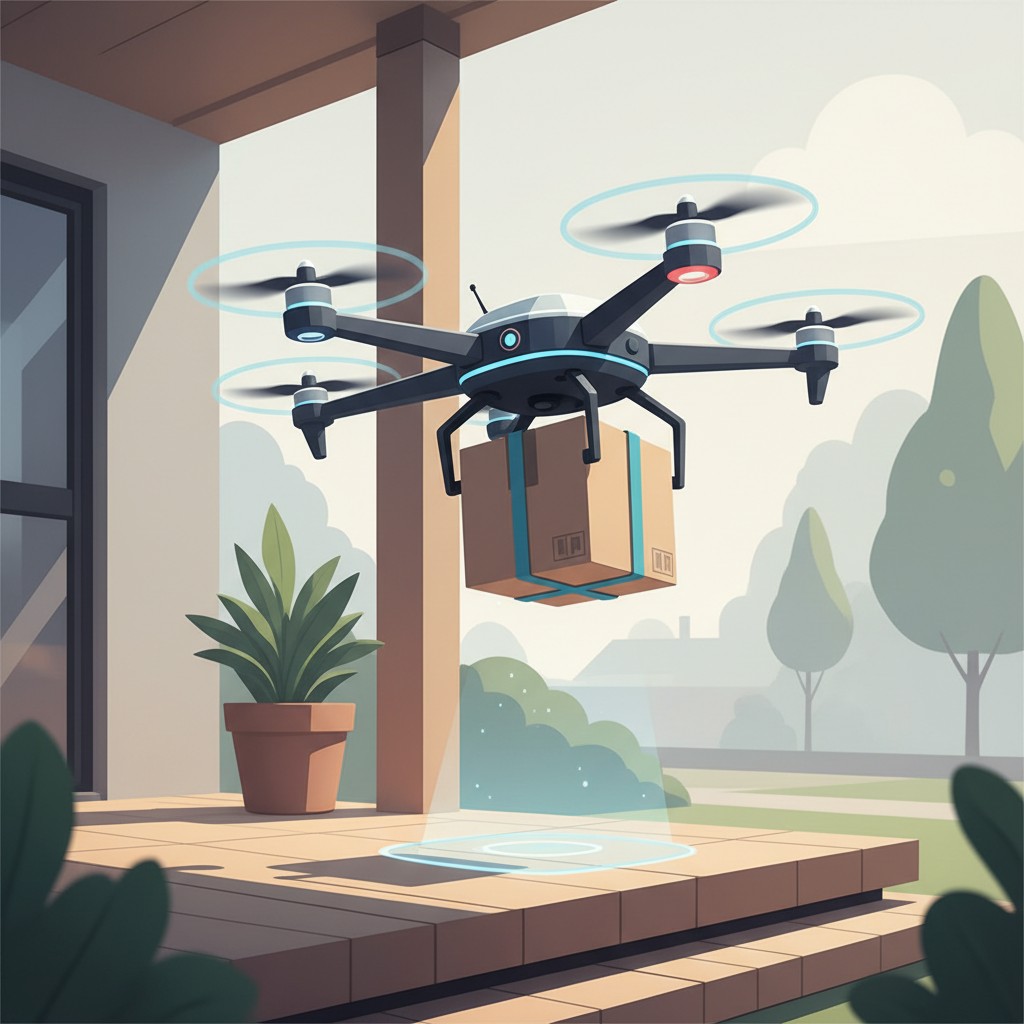
Amazon’s own figures put typical delivery at up to 60 minutes, with some orders arriving in as fast as 30. The drones use onboard cameras and sensors to confirm the landing zone is clear of people, pets, or vehicles before descending to drop the package from a safe height, a real design detail worth knowing for anyone with kids or pets who use the yard, since the drone needs a clear, identifiable drop zone and won’t complete a delivery into a space it reads as occupied or obstructed. Amazon states the onboard cameras aren’t feeding a live, employee-monitored video stream; they exist for the drone’s own navigation and obstacle detection, not human review, which matters for anyone who reasonably associates a camera-equipped device hovering over a house with a surveillance concern rather than a logistics one.
The Pricing Structure Nobody’s Highlighting
Coverage of this expansion has focused almost entirely on the city count. The cost structure is simple but worth stating plainly: Prime members get free drone delivery on orders of $50 or more, roughly $3 for smaller orders, and non-Prime customers pay a flat fee around $5 regardless of order size. That’s a meaningfully different economics than standard Amazon shipping, where the $50 free-shipping threshold already exists for non-Prime orders but doesn’t come with a delivery-speed guarantee attached to it. For a Prime member who already orders in the $50-plus range out of habit, drone delivery on an eligible small item effectively converts a normal next-day wait into a same-hour one at no extra cost, genuinely useful for the specific case of running out of something small and needing it within the hour, less useful as a reason to change general shopping habits.
Why 5 Pounds and a Shoebox, Specifically
The weight and size limits aren’t arbitrary marketing numbers; they’re a direct consequence of the physics of small multirotor aircraft. A drone light enough to hover reliably in residential airspace, land in a backyard-sized clearing, and do it economically at scale can only lift so much before the batteries, motors, and airframe needed to carry more weight make the whole unit too large, loud, and expensive to operate at the volume Amazon needs. That’s also why the covered categories skew toward small, dense items rather than bulky-but-light ones: a box of pharmacy items or a phone charger packs real value into a small, heavy-for-its-size shape, exactly the profile a small drone is built to carry efficiently, while something like a stack of paper towels would blow past the size limit long before it approached the weight one.
What Can Ground a Delivery Anyway
Small multirotor drones share a limitation that doesn’t show up in any of Amazon’s marketing materials: they’re meaningfully more weather-sensitive than a delivery van. High wind, heavy rain, and low visibility all affect a small aircraft’s ability to fly and land safely in a way that barely slows down a ground vehicle, which means the 30-to-60-minute window is a fair-weather promise more than a guaranteed one. Amazon’s public materials don’t publish a specific wind-speed or precipitation cutoff, but the operational pattern across drone-delivery services generally is to fall back to standard ground shipping automatically when conditions aren’t safe for flight, rather than delaying the order indefinitely. That’s worth setting expectations around for anyone in a newly covered city who assumes drone delivery replaces a same-day errand run regardless of forecast; on a stormy day, it quietly reverts to being ordinary Amazon shipping instead.
What This Doesn’t Change
It’s worth being direct about the scope here, because “drone delivery expanding sixfold” reads bigger than what it covers. This isn’t Amazon converting its general delivery network to drones, and it isn’t a service that will touch the majority of what a typical shopper buys in a given month. Anything electronics-adjacent beyond phone accessories, chargers, or similarly small items; anything apparel-adjacent beyond a single small item; any multi-item order that collectively exceeds the weight or size limit even if each item individually would qualify, all of that keeps moving through Amazon’s ordinary delivery network exactly as it does today. The 500-city number describes geographic reach, not a shift in what fraction of orders will use this method.
Where This Is Genuinely Useful
The practical value shows up in a narrower set of situations than the headline suggests: running out of a specific small, urgent item, medication, a phone cable, batteries, where waiting even a single day is a genuine inconvenience, in one of the newly covered metro areas, for an order that clears the $50 free-delivery threshold. That’s a common enough scenario to matter for a lot of shoppers, just not the universal shipping upgrade the expansion announcement implies on its own. Checking whether a specific ZIP code is covered, Amazon’s own site allows checking eligibility by address once a market goes live, rather than assuming metro-level coverage means every neighborhood is included, is worth doing once the rollout reaches a given area, rather than assuming a city being on the list means every address in it qualifies from day one.
The Bigger Pattern Worth Watching
This expansion sits inside a broader shift in how quickly online retail is expected to move, alongside same-day delivery windows tightening across most major marketplaces over the past few years. For shoppers, the practical upside isn’t that drones replace normal shipping; it’s that the definition of “urgent enough to pay for fast shipping” keeps shrinking toward genuinely small, cheap items, because the infrastructure to deliver them fast at near-zero marginal cost is starting to exist. Whether that’s worth factoring into how anyone shops depends entirely on being in one of the roughly 500 cities by year’s end, and whether what’s being bought is small enough to fit in a shoebox in the first place.